Have you ever heard of the document called Protocols of the Elders of Zion, also known as the Protocols of the Learned Elders of Zion? It is supposed to be a set of document detailing the Zionist plans to rule the world made ages ago and still in action until today.
Nevertheless have a look... This is from Protocol 3, the third out of a total of 24.
Hmm... Let me just list the protocols:-
Protocol I The Basic Doctrine
Protocol II Economic Wars
Protocol III Methods of Conquest
Protocol IV Materialism Replaces Religion
Protocol V Despotism and Modern Progress
Protocol VI Take-Over Technique
Protocol VII World-Wide Wars
Protocol VIII Provisional Government
Protocol IX Re-education
Protocol X Preparing for Power
Protocol XI The Totalitarian State
Protocol XII Control of the Press
Protocol XIII Distractions
Protocol XIV Assault on Religion
Protocol XV Ruthless Suppression
Protocol XVI Brainwashing
Protocol XVII Abuse of Authority
Protocol XVIII Arrest of Opponents
Protocol XIX Rulers and People
Protocol XX Financial Programme
Protocol XXI Loans and Credit
Protocol XXII Power of Gold
Protocol XXIII Instilling Obedience
Protocol XXIV Qualities of the Ruler
And here's Protocol III... Read and tremble!
PROTOCOL No. 3
1. To-day I may tell you that our goal is now only a few steps off. There remains a small space to cross and the whole long path we have trodden is ready now to close its cycle of the Symbolic Snake, by which we symbolize our people. When this ring closes, all the States of Europe will be locked in its coil as in a powerful vice.
2. The constitution scales of these days will shortly break down, for we have established them with a certain lack of accurate balance in order that they may oscillate incessantly until they wear through the pivot on which they turn. The GOYIM are under the impression that they have welded them sufficiently strong and they have all along kept on expecting that the scales would come into equilibrium. But the pivots - the kings on their thrones - are hemmed in by their representatives, who play the fool, distraught with their own uncontrolled and irresponsible power. This power they owe to the terror which has been breathed into the palaces. As they have no means of getting at their people, into their very midst, the kings on their thrones are no longer able to come to terms with them and so strengthen themselves against seekers after power. We have made a gulf between the far-seeing Sovereign Power and the blind force of the people so that both have lost all meaning, for like the blind man and his stick, both are powerless apart.
3. In order to incite seekers after power to a misuse of power we have set all forces in opposition one to another, breaking up their liberal tendencies towards independence. To this end we have stirred up every form of enterprise, we have armed all parties, we have set up authority as a target for every ambition. Of States we have made gladiatorial arenas where a lot of confused issues contend ... A little more, and disorders and bankruptcy will be universal ...
4. Babblers, inexhaustible, have turned into oratorical contests the sittings of Parliament and Administrative Boards. Bold journalists and unscrupulous pamphleteers daily fall upon executive officials. Abuses of power will put the final touch in preparing all institutions for their overthrow and everything will fly skyward under the blows of the maddened mob.
POVERTY OUR WEAPON
5. All people are chained down to heavy toil by poverty more firmly than ever. They were chained by slavery and serfdom; from these, one way and another, they might free themselves. These could be settled with, but from want they will never get away. We have included in the constitution such rights as to the masses appear fictitious and not actual rights. All these so-called "Peoples Rights" can exist only in idea, an idea which can never be realized in practical life. What is it to the proletariat laborer, bowed double over his heavy toil, crushed by his lot in life, if talkers get the right to babble, if journalists get the right to scribble any nonsense side by side with good stuff, once the proletariat has no other profit out of the constitution save only those pitiful crumbs which we fling them from our table in return for their voting in favor of what we dictate, in favor of the men we place in power, the servants of our AGENTUR ... Republican rights for a poor man are no more than a bitter piece of irony, for the necessity he is under of toiling almost all day gives him no present use of them, but the other hand robs him of all guarantee of regular and certain earnings by making him dependent on strikes by his comrades or lockouts by his masters.
WE SUPPORT COMMUNISM
6. The people, under our guidance, have annihilated the aristocracy, who were their one and only defense and foster-mother for the sake of their own advantage which is inseparably bound up with the well-being of the people. Nowadays, with the destruction of the aristocracy, the people have fallen into the grips of merciless money-grinding scoundrels who have laid a pitiless and cruel yoke upon the necks of the workers.
7. We appear on the scene as alleged saviours of the worker from this oppression when we propose to him to enter the ranks of our fighting forces - Socialists, Anarchists, Communists - to whom we always give support in accordance with an alleged brotherly rule (of the solidarity of all humanity) of our SOCIAL MASONRY. The aristocracy, which enjoyed by law the labor of the workers, was interested in seeing that the workers were well fed, healthy, and strong. We are interested in just the opposite - in the diminution, the KILLING OUT OF THE GOYIM. Our power is in the chronic shortness of food and physical weakness of the worker because by all that this implies he is made the slave of our will, and he will not find in his own authorities either strength or energy to set against our will. Hunger creates the right of capital to rule the worker more surely than it was given to the aristocracy by the legal authority of kings.
8. By want and the envy and hatred which it engenders we shall move the mobs and with their hands we shall wipe out all those who hinder us on our way.
9. WHEN THE HOUR STRIKES FOR OUR SOVEREIGN LORD OF ALL THE WORLD TO BE CROWNED IT IS THESE SAME HANDS WHICH WILL SWEEP AWAY EVERYTHING THAT MIGHT BE A HINDRANCE THERETO. (The Biblical "Anti-Christ?")
10. The GOYIM have lost the habit of thinking unless prompted by the suggestions of our specialists. Therefore they do not see the urgent necessity of what we, when our kingdom comes, shall adopt at once, namely this, that IT IS ESSENTIAL TO TEACH IN NATIONAL SCHOOLS ONE SIMPLE, TRUE PIECE OF KNOWLEDGE, THE BASIS OF ALL KNOWLEDGE - THE KNOWLEDGE OF THE STRUCTURE OF HUMAN LIFE, OF SOCIAL EXISTENCE, WHICH REQUIRES DIVISION OF LABOR, AND, CONSEQUENTLY, THE DIVISION OF MEN INTO CLASSES AND CONDITIONS. It is essential for all to know that OWING TO DIFFERENCE IN THE OBJECTS OF HUMAN ACTIVITY THERE CANNOT BE ANY EQUALITY, that he, who by any act of his compromises a whole class, cannot be equally responsible before the law with him who affects no one but only his own honor. The true knowledge of the structure of society, into the secrets of which we do not admit the GOYIM, would demonstrate to all men that the positions and work must be kept within a certain circle, that they may not become a source of human suffering, arising from an education which does not correspond with the work which individuals are called upon to do. After a thorough study of this knowledge, the peoples will voluntarily submit to authority and accept such position as is appointed them in the State. In the present state of knowledge and the direction we have given to its development of the people, blindly believing things in print - cherishes - thanks to promptings intended to mislead and to its own ignorance - a blind hatred towards all conditions which it considers above itself, for it has no understanding of the meaning of class and condition.
JEWS WILL BE SAFE
11. THIS HATRED WILL BE STILL FURTHER MAGNIFIED BY THE EFFECTS of an ECONOMIC CRISES, which will stop dealing on the exchanges and bring industry to a standstill. We shall create by all the secret subterranean methods open to us and with the aid of gold, which is all in our hands, A UNIVERSAL ECONOMIC CRISES WHEREBY WE SHALL THROW UPON THE STREETS WHOLE MOBS OF WORKERS SIMULTANEOUSLY IN ALL THE COUNTRIES OF EUROPE. These mobs will rush delightedly to shed the blood of those whom, in the simplicity of their ignorance, they have envied from their cradles, and whose property they will then be able to loot.
12. "OURS" THEY WILL NOT TOUCH, BECAUSE THE MOMENT OF ATTACK WILL BE KNOWN TO US AND WE SHALL TAKE MEASURES TO PROTECT OUR OWN.
13. We have demonstrated that progress will bring all the GOYIM to the sovereignty of reason. Our despotism will be precisely that; for it will know how, by wise severities, to pacificate all unrest, to cauterize liberalism out of all institutions.
14. When the populace has seen that all sorts of concessions and indulgences are yielded it, in the same name of freedom it has imagined itself to be sovereign lord and has stormed its way to power, but, naturally like every other blind man, it has come upon a host of stumbling blocks. IT HAS RUSHED TO FIND A GUIDE, IT HAS NEVER HAD THE SENSE TO RETURN TO THE FORMER STATE and it has laid down its plenipotentiary powers at OUR feet. Remember the French Revolution, to which it was we who gave the name of "Great": the secrets of its preparations are well known to us for it was wholly the work of our hands.
15. Ever since that time we have been leading the peoples from one disenchantment to another, so that in the end they should turn also from us in favor of that KING-DESPOT OF THE BLOOD OF ZION, WHOM WE ARE PREPARING FOR THE WORLD.
16. At the present day we are, as an international force, invincible, because if attacked by some we are supported by other States. It is the bottomless rascality of the GOYIM peoples, who crawl on their bellies to force, but are merciless towards weakness, unsparing to faults and indulgent to crimes, unwilling to bear the contradictions of a free social system but patient unto martyrdom under the violence of a bold despotism - it is those qualities which are aiding us to independence. From the premier-dictators of the present day, the GOYIM peoples suffer patiently and bear such abuses as for the least of them they would have beheaded twenty kings.
17. What is the explanation of this phenomenon, this curious inconsequence of the masses of the peoples in their attitude towards what would appear to be events of the same order?
18. It is explained by the fact that these dictators whisper to the peoples through their agents that through these abuses they are inflicting injury on the States with the highest purpose - to secure the welfare of the peoples, the international brotherhood of them all, their solidarity and equality of rights. Naturally they do not tell the peoples that this unification must be accomplished only under our sovereign rule.
19. And thus the people condemn the upright and acquit the guilty, persuaded ever more and more that it can do whatsoever it wishes. Thanks to this state of things, the people are destroying every kind of stability and creating disorders at every step.
20. The word "freedom" brings out the communities of men to fight against every kind of force, against every kind of authority even against God and the laws of nature. For this reason we, when we come into our kingdom, shall have to erase this word from the lexicon of life as implying a principle of brute force which turns mobs into bloodthirsty beasts.
21. These beasts, it is true, fall asleep again every time when they have drunk their fill of blood, and at such time can easily be riveted into their chains. But if they be not given blood they will not sleep and continue to struggle.

-----------------------
This blogspot is a medium to share my thoughts and adventures apart from promoting my books. Below are the books which have been written or authored and published by myself.

"Berpetualang ke Aceh: Mencari Diri dan Erti".
ISBN 983-42031-0-1, Jun 2006

"Berpetualang ke Aceh: Membela Syiar yang Asal"
ISBN 983-42031-1-x, May 2007

"Berpetualang ke Aceh: Sirih Pulang ke Gagang?"
ISBN 978-983-42031-2-2, November 2007
It is interesting to note that while these books were written in Malay it has gained enough attention to merit being part of the collections of the American Library of Congress and National Library of Australia. Look here and here.

While the first three books were published by my own company, the fourth titled "Rumah Azan" was published in April 2009 by a company called Karnadya with the help of the Malaysian national literary body Dewan Bahasa dan Pustaka. It features beautiful pictures along with stories behind selected mosques which could be related to the history of Islam and the Malays alongside the formation of the Malaysian nation. Look at the article A collaboration of old collegemates - the book "Rumah Azan".

My fifth book "Ahlul Bait (Family) of Rasulullah SAW and Malay Sultanates", an English translation and adaptation of the Malay book "Ahlul Bait (Keluarga) Rasulullah SAW dan Kesultanan Melayu" authored by Hj Muzaffar Mohamad and Tun Suzana Othman was published early 2010. Look here... My 5th book is out! Ahlul Bait (Family) of Rasulullah SAW and the Malay Sultanates... . For more information check out my Malay blogspot CATATAN SI MERAH SILU.

Like my fourth book "Rumah Azan", the sixth book "Kereta Api Menuju Destinasi" is also a coffee-table book which is published by the company Karnadya with the cooperation of Dewan Bahasa dan Pustaka (the main Malay literary body in Malaysia). Coming out January 2011 it features pictures and stories on the adventure travelling by train to all of Peninsular Malaysia along with the interesting places which could be reached this way.

My seventh book "Jejak keluarga Yakin : Satu sketsa sejarah" in turn is a coffee-table book which is written, editted, designed and has pictures taken by me. Coming out of the factory October 2011, this book which combines family history with history of places such as Singapura, Johor, Batu Pahat, Muar and in fact the history of the island of Java and England has been reviewed with me interviewed live in the program Selamat Pagi Malaysia at RTM1. Look at the article Siaran langsung ulasan buku "Jejak keluarga Yakin : Satu sketsa sejarah" dan temu ramah di Selamat Pagi Malaysia. Some selected contents have been featured in Sneak peek "Jejak keluarga Yakin : Satu sketsa sejarah".
-----------------------

The "Berpetualang ke Aceh" series of novels could be obtained in e-book form. Enter http://www.e-sentral.com/, click general novel and go to page 4. You can also type the word "Aceh" at the search box. Or click straight Book 1, Book 2 and Book 3.
Wednesday, December 13, 2006


A history of Aceh
Found this at aceh.net. Thought it fits nicely here...
Aceh is a region on the northern tip of Sumatra. Aceh first rose to importance as a center of resistance to the Portuguese. Aceh went into decline when the Dutch established a presence in Malacca.
It was used as a counter to the Dutch by the British, and an Anglo-Dutch treaty guaranteed Aceh's independence in 1824. In 1871, the Treaty of Sumatra gave the Dutch a free hand in Aceh in return for recognition of British rights in the Horn of Africa. The Dutch invaded Aceh in 1873. While the Dutch gained control of the cities, they could not project their power into the countryside. Major war lead by strong Acehnese resistance leaders ended in 1912. Outside main cities, guerrilla war continued until 1942.
Overview
Chinese chronicles from as early as the sixth century speak of a Buddhist kingdom called Po-Li on the northern tip of what is now Sumatra. Arabic writings and Indian inscriptions from around the 9th century also mention this area and its obvious importance.
Of all the regions in Indonesia, Aceh, at the northwestern end of Sumatra, is the first to have contact and be influenced by the outside world. Ironically, it is still one of the least known regions of Indonesia, even among Indonesians themselves.
Aceh has a fascinating history which over the centuries has shaped and transformed the region into what it is today. In 1292, Marco Polo, on his epic voyage from China visited Sumatra on his way to Persia and reported that in the northern part of the island there were as many as six busy trading ports including Perlak, Samudera and Lamri. Islamic writings and Indian inscriptions from around the ninth century also name the area and its importance, primarily as a busy and highly strategic trading posts.
The first Islamic kingdom of Perlak was established in the year 804 about 100 years after Islam is first believed to have reached the archipelago. In 1511, the Portuguese seized the important strategic port of Malacca, pushing many Asian and Arabic traders to call instead on the developing port of Aceh, bringing with them wealth and prosperity. Aceh's dominance in trade and politics in northern parts of Sumatra and in the entire region had begun and would last until it reached its zenith between 1610 and 1640.
Aceh's decline began with the death of Sultan Iskandar Thani in 1641, and as a result the British and Dutch both began vying for domination of the area. Eventually the signing of the London Treaty in 1824 saw the Dutch gain control of all British possessions in Sumatra in return for their surrender of enterprises in India and withdrawal of all claims on Singapore.
The Dutch found gaining control of Aceh to be more difficult than they had anticipated. It was a long drawn out struggle for the Dutch in their attempts to subdue the recalcitrant Acehnese. The Aceh War, which lasted intermittently from 1873 to 1942, was the longest ever fought by Holland.
From Po-Li to Aceh Darussalam
"The city of Achin, if you could call it a city, is incredibly spread out, and is built in the forest itself in such a way that no even one home is visible until we find ourselves directly in front of it. And everywhere we went there were houses and people, so that I felt that the city covered the whole land," John Davis, a British observer on a Dutch ship which visited Aceh in 1600 AD wrote. The kingdom of Aceh he spoke of was ruled by Alaidin Riayat Syah.
The history of the Liang Dynasty of China (506-556) spoke of a kingdom called Po-Li to be found on the northern tip of Sumatra. This same kingdom was again mentioned in the history of Sui Dynasty (581-671). "The people in this land are masters at throwing a disk, about the size of a small mirror, whose edges are cerated and sharp, and in whose center a hole is cut. If they throw this weapon they never miss. The other weapons they use are much the same as those existing in China."
In the history of the T'ang Dynasty (618-906) the existence of this kingdom is listed in Book 222. "There is also found a bird called s'ari, which can understand the speech of man. It is black, with a read head, and claws like those of an eagle." The bird referred to was the minah (Gracula religoisa).
Several Arabic writings of the early 9th century also mention an area called Rami or Ramni, and sometimes Lambri. "On that island - I am referring to Lambri - there are many elephants. There is also sapang wood, bamboo and a tribe of cannibals," the Arab notes report. And most experts agree that the positioning of the area indicated is that of what is now known as Northern Sumatra.
In an inscription found in Tanjore, India which was carved in around 1030-31, the name Ilamuridesam is used to refer to a place near Manakkavaram (Greater Nickobar island). Texts from 13th century China also refer to a country called Lan-Wuli or Lan-Li. All these names are very similar to Lamuri, which was mentioned in earlier reports.
At the end of the 13th century, Marco Polo, the adventurer from Venice reported that in the northern part of Sumatra there were to be found as many as 6 trading ports. These were Ferlec, Basman, Smudra, Dagroian, Fansur and Lambri. The name Lamuri was also refered to by Arab explorers like Ibn Sa'id (end of the 13th century), Rasyid ad-Din (1310), and Abulfide (1273-1331). And in 1323 the Christian Father Odoric de Pordenone angrily wrote of the habits of the people of Lamuri, whom he described as savages because they practiced poligamy and cannibalism.
Cheng-Ho, and admiral serving the emperor of China of the Ming Dynasty, in the first part of Sumatra: A-lu (Aru), Su-men-ta-la, or Hsiu-wen-ta-la (Samudra) and Lanwul-li, or Lan-po-li (Lamuri). Concerning Samudra he reported that the region exported precious stones, other kinds of stone, indigo, rhinoceros, pumice stone, gaharu, kalambak, and pucuk wood, cloves, incense, daggers, arches, tin, pepper, sapan wood, belereng and other things. According to the same notes, after a struggle for the throne the name of the region referred to was change to A-tsi (Aceh).
The influence of Hinduism and Buddhism was also felt in this region, but it is not clear when this first occurred. The are is close to India so it is assumed that this influence existed there long before it did in other parts of Sumatra or Java. In the 54th book of the Ling Dynasty history there are several indications that the religion embraced by the king of Po-Li was Buddhism. Several other histories report the presence of Hinduism in Aceh. However it is all but impossible to find any physical sign of this presence, so it is difficult to reconstruct what type of influence India actually had in Aceh. This is probably because of the influence of the Islamic religion in the 7th and 8th centuries A.D.
"All aspects of the culture which were in direct opposition to Islamic law and teachings were wiped out completely" according to A. Hasjmy. Almost all structures and objects related to Indian influence were destroyed and almost no trace at all is left.
According to A. Hajmy the mosque in Indrapuri (Aceh Besar) was built on the foundation of a huge temple. "Its form was similar to that of the Borobudur temple."
The first Islamic kingdoms in Aceh were Perlak, Lamuri and Pasai. The kingdom of Pasai was the first to embrace Islam in Southeast Asia. Two other Islamic kingdoms of Aceh, Samudra Pasai (14th and 15ths centuries) and Aceh Darussalam (16th and 17th centuries), had major impact on the development and expansion of Islam in Indonesia. The religious, philosophic and literary works of the ulemas of Aceh opened up new horizons all over Indonesia.
The name Aceh itself began to be used more definitely around 1520 when Tome Pires of Portugal wrote, "Aceh is the first nation along the coast of Sumatra and is bordered by Lamri, which extends into the interior." Concerning the king of the region Tome Pires refers to him as being a Moslem king with power great enough to bring all of his enemies under control.
Denys Lombard, and expert on the history of Aceh, in his book, "The Kingdoms of Aceh" (1986) speculates that the king referred to was probably Ali Mughayat Syah, who is believed to have been the establisher of Islamic power. This king won the first sea war against the Portuguese in May 1521. Under his rule, and those of his successors, Aceh continued to expand its borders into the whole of Sumatra island and into Semenanjung, Malaysia.
The golden age of Aceh came during the period of kingdom of Aceh Darussalam (Land of Peace) under the rule of Sultan Iskandar Muda (1607-1636). According to Ausgustin de Beaulieu, a French admiral, the Aceh kingdom was the strongest of all the neighboring nations in terms of its sea power. In its three main harbors as many as 100 war ships were on the alert and ready to sail at a moment's notice. "A third of them were larger than any war ship ever seen in Christiandom," Beaulieu wrote. He also recorded the information that each ship carried three cannons and 40 tons of shells, and were manned by between 600 and 800 men.
Peter Mundy, a Briton, in 1673 reported that Aceh had an armada of 200 large ships, besides numerous large and small boats with sails made of woven matting or rattan. The Portuguese, the foe of Aceh, called these large Acehnese ships Espanto del Mundo or the "bogey men of the world". These ships were about 100 meters long, with three sails and equipped with 100 guns. "Even though our eyes were accustomed to seeing things of great beauty, we all amazed to see this (the ships)," Faria y Sousa, a Spaniard, who worked for the Portuguese, reported.
On land Aceh's army featured the use of elephants, which were greatly feared. Beaulieu reported that the elephants forces numbered as many as 900. These forces were supported by a cavalry mounted on 200 horses. The Aceh kingdom also had a force of at least 40,000 foot soldiers. With this type of military strength Aceh expanded its territory and successfully fought off the Portuguese in areas as far away as Malacca and Semanjung, Malaysia. Because these forces inspired such confidence the people of Aceh did not bother to build high, thick walls to protect Aceh city. Explorers from Europe who are used to seeing such fortresses in Europe and India were amazed that Aceh had none.
As time passed the Dutch became the threat instead of the Portuguese and Aceh was the only part of Indonesia that had yet to fall under the influence of the colonial forces at the first of 20th century.
The Aceh war (1873-1942) was the most major war ever fought by the Dutch and it claimed over 100,000 lives, including that of the Dutch Major General J.H.R. Kohler.
On Aceh's side many heros and heroines surfaced, many of them dying, during this prolonged struggle, among them being: Teungku Chik di Tiro, Teuku Umar, Cut Nyak Dien, Panglima Polem, Cut Meutia, and many, many more. Aceh was the last region in Indonesia to fall to the Dutch colonial forces, and the first to break away.
Aceh is a region on the northern tip of Sumatra. Aceh first rose to importance as a center of resistance to the Portuguese. Aceh went into decline when the Dutch established a presence in Malacca.
It was used as a counter to the Dutch by the British, and an Anglo-Dutch treaty guaranteed Aceh's independence in 1824. In 1871, the Treaty of Sumatra gave the Dutch a free hand in Aceh in return for recognition of British rights in the Horn of Africa. The Dutch invaded Aceh in 1873. While the Dutch gained control of the cities, they could not project their power into the countryside. Major war lead by strong Acehnese resistance leaders ended in 1912. Outside main cities, guerrilla war continued until 1942.
Overview
Chinese chronicles from as early as the sixth century speak of a Buddhist kingdom called Po-Li on the northern tip of what is now Sumatra. Arabic writings and Indian inscriptions from around the 9th century also mention this area and its obvious importance.
Of all the regions in Indonesia, Aceh, at the northwestern end of Sumatra, is the first to have contact and be influenced by the outside world. Ironically, it is still one of the least known regions of Indonesia, even among Indonesians themselves.
Aceh has a fascinating history which over the centuries has shaped and transformed the region into what it is today. In 1292, Marco Polo, on his epic voyage from China visited Sumatra on his way to Persia and reported that in the northern part of the island there were as many as six busy trading ports including Perlak, Samudera and Lamri. Islamic writings and Indian inscriptions from around the ninth century also name the area and its importance, primarily as a busy and highly strategic trading posts.
The first Islamic kingdom of Perlak was established in the year 804 about 100 years after Islam is first believed to have reached the archipelago. In 1511, the Portuguese seized the important strategic port of Malacca, pushing many Asian and Arabic traders to call instead on the developing port of Aceh, bringing with them wealth and prosperity. Aceh's dominance in trade and politics in northern parts of Sumatra and in the entire region had begun and would last until it reached its zenith between 1610 and 1640.
Aceh's decline began with the death of Sultan Iskandar Thani in 1641, and as a result the British and Dutch both began vying for domination of the area. Eventually the signing of the London Treaty in 1824 saw the Dutch gain control of all British possessions in Sumatra in return for their surrender of enterprises in India and withdrawal of all claims on Singapore.
The Dutch found gaining control of Aceh to be more difficult than they had anticipated. It was a long drawn out struggle for the Dutch in their attempts to subdue the recalcitrant Acehnese. The Aceh War, which lasted intermittently from 1873 to 1942, was the longest ever fought by Holland.
From Po-Li to Aceh Darussalam
"The city of Achin, if you could call it a city, is incredibly spread out, and is built in the forest itself in such a way that no even one home is visible until we find ourselves directly in front of it. And everywhere we went there were houses and people, so that I felt that the city covered the whole land," John Davis, a British observer on a Dutch ship which visited Aceh in 1600 AD wrote. The kingdom of Aceh he spoke of was ruled by Alaidin Riayat Syah.
The history of the Liang Dynasty of China (506-556) spoke of a kingdom called Po-Li to be found on the northern tip of Sumatra. This same kingdom was again mentioned in the history of Sui Dynasty (581-671). "The people in this land are masters at throwing a disk, about the size of a small mirror, whose edges are cerated and sharp, and in whose center a hole is cut. If they throw this weapon they never miss. The other weapons they use are much the same as those existing in China."
In the history of the T'ang Dynasty (618-906) the existence of this kingdom is listed in Book 222. "There is also found a bird called s'ari, which can understand the speech of man. It is black, with a read head, and claws like those of an eagle." The bird referred to was the minah (Gracula religoisa).
Several Arabic writings of the early 9th century also mention an area called Rami or Ramni, and sometimes Lambri. "On that island - I am referring to Lambri - there are many elephants. There is also sapang wood, bamboo and a tribe of cannibals," the Arab notes report. And most experts agree that the positioning of the area indicated is that of what is now known as Northern Sumatra.
In an inscription found in Tanjore, India which was carved in around 1030-31, the name Ilamuridesam is used to refer to a place near Manakkavaram (Greater Nickobar island). Texts from 13th century China also refer to a country called Lan-Wuli or Lan-Li. All these names are very similar to Lamuri, which was mentioned in earlier reports.
At the end of the 13th century, Marco Polo, the adventurer from Venice reported that in the northern part of Sumatra there were to be found as many as 6 trading ports. These were Ferlec, Basman, Smudra, Dagroian, Fansur and Lambri. The name Lamuri was also refered to by Arab explorers like Ibn Sa'id (end of the 13th century), Rasyid ad-Din (1310), and Abulfide (1273-1331). And in 1323 the Christian Father Odoric de Pordenone angrily wrote of the habits of the people of Lamuri, whom he described as savages because they practiced poligamy and cannibalism.
Cheng-Ho, and admiral serving the emperor of China of the Ming Dynasty, in the first part of Sumatra: A-lu (Aru), Su-men-ta-la, or Hsiu-wen-ta-la (Samudra) and Lanwul-li, or Lan-po-li (Lamuri). Concerning Samudra he reported that the region exported precious stones, other kinds of stone, indigo, rhinoceros, pumice stone, gaharu, kalambak, and pucuk wood, cloves, incense, daggers, arches, tin, pepper, sapan wood, belereng and other things. According to the same notes, after a struggle for the throne the name of the region referred to was change to A-tsi (Aceh).
The influence of Hinduism and Buddhism was also felt in this region, but it is not clear when this first occurred. The are is close to India so it is assumed that this influence existed there long before it did in other parts of Sumatra or Java. In the 54th book of the Ling Dynasty history there are several indications that the religion embraced by the king of Po-Li was Buddhism. Several other histories report the presence of Hinduism in Aceh. However it is all but impossible to find any physical sign of this presence, so it is difficult to reconstruct what type of influence India actually had in Aceh. This is probably because of the influence of the Islamic religion in the 7th and 8th centuries A.D.
"All aspects of the culture which were in direct opposition to Islamic law and teachings were wiped out completely" according to A. Hasjmy. Almost all structures and objects related to Indian influence were destroyed and almost no trace at all is left.
According to A. Hajmy the mosque in Indrapuri (Aceh Besar) was built on the foundation of a huge temple. "Its form was similar to that of the Borobudur temple."
The first Islamic kingdoms in Aceh were Perlak, Lamuri and Pasai. The kingdom of Pasai was the first to embrace Islam in Southeast Asia. Two other Islamic kingdoms of Aceh, Samudra Pasai (14th and 15ths centuries) and Aceh Darussalam (16th and 17th centuries), had major impact on the development and expansion of Islam in Indonesia. The religious, philosophic and literary works of the ulemas of Aceh opened up new horizons all over Indonesia.
The name Aceh itself began to be used more definitely around 1520 when Tome Pires of Portugal wrote, "Aceh is the first nation along the coast of Sumatra and is bordered by Lamri, which extends into the interior." Concerning the king of the region Tome Pires refers to him as being a Moslem king with power great enough to bring all of his enemies under control.
Denys Lombard, and expert on the history of Aceh, in his book, "The Kingdoms of Aceh" (1986) speculates that the king referred to was probably Ali Mughayat Syah, who is believed to have been the establisher of Islamic power. This king won the first sea war against the Portuguese in May 1521. Under his rule, and those of his successors, Aceh continued to expand its borders into the whole of Sumatra island and into Semenanjung, Malaysia.
The golden age of Aceh came during the period of kingdom of Aceh Darussalam (Land of Peace) under the rule of Sultan Iskandar Muda (1607-1636). According to Ausgustin de Beaulieu, a French admiral, the Aceh kingdom was the strongest of all the neighboring nations in terms of its sea power. In its three main harbors as many as 100 war ships were on the alert and ready to sail at a moment's notice. "A third of them were larger than any war ship ever seen in Christiandom," Beaulieu wrote. He also recorded the information that each ship carried three cannons and 40 tons of shells, and were manned by between 600 and 800 men.
Peter Mundy, a Briton, in 1673 reported that Aceh had an armada of 200 large ships, besides numerous large and small boats with sails made of woven matting or rattan. The Portuguese, the foe of Aceh, called these large Acehnese ships Espanto del Mundo or the "bogey men of the world". These ships were about 100 meters long, with three sails and equipped with 100 guns. "Even though our eyes were accustomed to seeing things of great beauty, we all amazed to see this (the ships)," Faria y Sousa, a Spaniard, who worked for the Portuguese, reported.
On land Aceh's army featured the use of elephants, which were greatly feared. Beaulieu reported that the elephants forces numbered as many as 900. These forces were supported by a cavalry mounted on 200 horses. The Aceh kingdom also had a force of at least 40,000 foot soldiers. With this type of military strength Aceh expanded its territory and successfully fought off the Portuguese in areas as far away as Malacca and Semanjung, Malaysia. Because these forces inspired such confidence the people of Aceh did not bother to build high, thick walls to protect Aceh city. Explorers from Europe who are used to seeing such fortresses in Europe and India were amazed that Aceh had none.
As time passed the Dutch became the threat instead of the Portuguese and Aceh was the only part of Indonesia that had yet to fall under the influence of the colonial forces at the first of 20th century.
The Aceh war (1873-1942) was the most major war ever fought by the Dutch and it claimed over 100,000 lives, including that of the Dutch Major General J.H.R. Kohler.
On Aceh's side many heros and heroines surfaced, many of them dying, during this prolonged struggle, among them being: Teungku Chik di Tiro, Teuku Umar, Cut Nyak Dien, Panglima Polem, Cut Meutia, and many, many more. Aceh was the last region in Indonesia to fall to the Dutch colonial forces, and the first to break away.
Monday, December 11, 2006
The Tale of Keramat Kuala Bidor 3 – And so the story goes…
 The tomb of Keramat Kuala Bidor in Perak
Continued from the article “The Tale of Keramat Kuala Bidor 2 – Touching a bit on the world shadow government”. This story is translated/adapted from the Malay novel “Berpetualang ke Aceh”.
Once upon a time, a long time ago in Sumatera, there were two brothers fighting for the throne of a kingdom. The elder one who deserved the throne more became disappointed and broken-hearted that his own brother would go to any lengths just to become the ruler, and so he left the whole fray and left the kingdom with his beloved wife and only the clothes they are wearing.
They rowed on a small boat across the Straits of Malacca. Arrived at the Perak river and landed in Teluk Intan. That’s where they stayed and lived… By planting vegetables and fishing for a living.
Nenek said, during that time the Kingdom of Perak have not existed yet… Don’t know how long ago this happened… The name Teluk Intan was not yet to be, so were the name Perak and the Perak river. But there was already a small fishing settlement there and so there were some populace. Not sure though where they came from, which kingdom there belong to or which king hold sway over them. According to official history, the Perak Kingdom was started in 1528 AD… So this story must have happened at least 500 years ago.
What is strange, Nenek said Keramat Kuala Bidor used to travel to and fro his orchard in Bidor. He went after Zuhur (the prayer after noon) and returned before Maghrib (time for the sunset twilight prayers). Come to think of it, it would take an hour by car to go from Teluk Intan to Bidor in this modern times, so how could anyone do it during that period travelling through thick jungle and vegetation to and fro with time to work an orchard all within a space of five hours? Did he rode a horse? As far as Rasyid knows, the legendary man was too poor to afford any mode of transportation… What can you say, after all he is a very poor man who owned only a set of clothers, can’t afford to have an ox what more a horse. Or… Perhaps he rode a tiger? Because there are tales saying he did befriended a tiger with one lame foot known in legends as “Harimau Tepok”…
Keramat Kuala Bidor also liked to fish in the wee hours of the morning and give the catch to the villagers without them knowing. Right after he made his catch, he would put a fish at the door of each house before Subuh (time for morning prayers)… The minute one opens the door, there is a fish in front but nobody knew where it came from. The man just took one or two for his own consumption with the wife.
Such was the simple life led by this legendary figure and his woman… They only owned a piece of good clean cloth. That is the cloth used in turn for their prayers but nevertheless they lead a blissful and happy life.
Nenek said the guy could have had a very easy life if he wanted to, anytime if he needs it as he was blessed with many natural-born talents. But Keramat Kuala Bidor is not the type of person to relish wealth and treasure, or any form of worldly luxury and goods.
Rasyid was moved to hear this story. At the core of his being came the thought how happy he would be if he got a wife like that of Keramat Kuala Bidor, the kind of thoughtful pious woman who is willing to accept anything the husband has to give, even though he has nothing at all.
To him this is the example of a woman who truly follows the injunctions laid out in the holy book Al-Quran regarding the rights of woman to receive from her husband which sounds something like this: “Whenever the husband eats, and so the wife. Whenever the husband is clothed, and so the wife too”. This means, the woman is pleased and accepts whatever the husband could afford, not to make demands asking him to buy what-nots as is the case nowadays just to follow the trend or the times and thus forcing the husband to look for extra money just to keep up with the Joneses… Whenever the neighbours have new furnitures, and so the wife demands from the husband… That notwithstanding other things… In the end the husband suffers from migraine just to keep the wife happy.
According to the real injunctions of the Quran, if the husband has nothing to eat, then the wife should not mind to be patient in hunger too. So this would not be a burden on the husband especially in this modern times where one is often forced to go against one’s principles just to make ends meet, where clean and “not-so-clean” money are mixed and it is hard to recognise which is which, where usury holds sway until it becomes the ingredient of every human being.
Believe this ooo dear womankind, in an environment full of love and acceptance such as described above, there exist no man who would consciously allow his wife to suffer in hunger or not have proper clothing. There would not arise the man’s anger in having to compromise his principles just to chase the luxurios life demanded by some wives. If the wife is really pleased with whatever the husband has got to give, then he would have the peace of mind to really pray and lead his life according to the will of Allah. Meanwhile those men who are given certain principles to live and fight for especially those involving the purity and sovereignity of the religion, people and the country would be able to carry out their task whole-heartedly.
Eh… This Rasyid has gone overboard with these thoughts… Perhaps what Nenek told him about how Keramat Kuala Bidor lead his life with the wife made him remember his very own dear sweet-heart…
Friday, December 08, 2006
The Zionist Conspiracy
Last night I had trouble going to sleep. So after spending sometime trashing my body to find a sleep-inducing position, I woke up and turned on the laptop and shifted through MyDocuments. And so I found something I wrote 4 years ago, an outline in English on what was to be my first attempt at writing a book, a book in Malay. This happened a few months after leaving my job as a journalist for the Malaysian English-daily, The New Straits Times.
The actual articles which would have formed the book following the outline was written in Malay. Nevertheless, due to some problems, the book was never completed... Instead I wrote the Malay novel "Berpetualang ke Aceh: Mencari Diri dan Erti" and published it in June 2006.
Anyway perhaps for posterity, perhaps to give others points to ponder and food for thought eh?Here is the outline as it was written 4 years ago...
Oh... The words "Yahudi ingin memerintah dunia" can directly translated as "The Jews want to rule the world"... So there!
YAHUDI INGIN MEMERINTAH DUNIA
Outline - main themes
1. Sept 11 attack on WTC was actually organised by the Jews. points - north tower was hit first but south tower which was hit some 20 minutes later was the first to crumble. Also to check. The first plane was from an NY airport, the second from Boston meaning the first had more fuel on board. The towers also crumbled like a proper demolition job which needs explosives put and detonated at intervals but explanation offered was they crumbled like this because of jet fuel. SO how can the second tower crumble first when less fuel was involved and it was hit some 20 minutes later? What about black boxes or communications with ground control. How can the planes approach urban areas without some warning from the ground. Also the global hawk theory.
Check the facts that some 4,000 Jews who worked in the WTC were all on holiday when this happened. Strange huh? Also that shares expected to fall like airline shares were sold just before this happened while shares expected to rise like those for companies dealing with security products were snapped up. Attack also happened after George W. Bush were barely months into his office. Note that the whole American politics was divided in half after the Bush-Gore presidential fight but now Bush got total support. Also attack happened when US economy were facing recession. Wars have been known to be waged to revive economies while making the people's attention turn abroad. The attack also opened the way for control like phone taping and all soemthing the American people are bound to oppose under freedom of speech and right to privacy. But now they are giving that away in the name of national security.
2. The Jewish plan - Protocols of the Elders of Zion - this was mentioned and taken very seriously by Ford motor company founder who wrote the book the International Jews. Control of world finances. Dispersion of opposing ideas - Capitalism versus Marxism and all. An economy run through usury of riba The Illuminati plan - the fomenting of three world wars. Note: The UN and Bretton Woodsa institutions were created for these purposes
3. Signs for a third world war - Use Aquarian age theory, the propechies and books Stories of Dajjal - the false prophet - the rebuilding of the Temple of Solomon
4. Were do we (Malaysians) fit in this - The meeting of descendants of Alexander the Great and Prophet Muhammad. The fact that we have nine Sultans in Malaysia when that of our neighbour Indonesia have practically been destroyed.Use Hikayats like that of Raja-raja Pasai. Also the story about Ratu Adil and the contention by some that barang-barang ampuh from Jawa are disappearing only to reappear in the Klang Valley.
The actual articles which would have formed the book following the outline was written in Malay. Nevertheless, due to some problems, the book was never completed... Instead I wrote the Malay novel "Berpetualang ke Aceh: Mencari Diri dan Erti" and published it in June 2006.
Anyway perhaps for posterity, perhaps to give others points to ponder and food for thought eh?Here is the outline as it was written 4 years ago...
Oh... The words "Yahudi ingin memerintah dunia" can directly translated as "The Jews want to rule the world"... So there!
YAHUDI INGIN MEMERINTAH DUNIA
Outline - main themes
1. Sept 11 attack on WTC was actually organised by the Jews. points - north tower was hit first but south tower which was hit some 20 minutes later was the first to crumble. Also to check. The first plane was from an NY airport, the second from Boston meaning the first had more fuel on board. The towers also crumbled like a proper demolition job which needs explosives put and detonated at intervals but explanation offered was they crumbled like this because of jet fuel. SO how can the second tower crumble first when less fuel was involved and it was hit some 20 minutes later? What about black boxes or communications with ground control. How can the planes approach urban areas without some warning from the ground. Also the global hawk theory.
Check the facts that some 4,000 Jews who worked in the WTC were all on holiday when this happened. Strange huh? Also that shares expected to fall like airline shares were sold just before this happened while shares expected to rise like those for companies dealing with security products were snapped up. Attack also happened after George W. Bush were barely months into his office. Note that the whole American politics was divided in half after the Bush-Gore presidential fight but now Bush got total support. Also attack happened when US economy were facing recession. Wars have been known to be waged to revive economies while making the people's attention turn abroad. The attack also opened the way for control like phone taping and all soemthing the American people are bound to oppose under freedom of speech and right to privacy. But now they are giving that away in the name of national security.
2. The Jewish plan - Protocols of the Elders of Zion - this was mentioned and taken very seriously by Ford motor company founder who wrote the book the International Jews. Control of world finances. Dispersion of opposing ideas - Capitalism versus Marxism and all. An economy run through usury of riba The Illuminati plan - the fomenting of three world wars. Note: The UN and Bretton Woodsa institutions were created for these purposes
3. Signs for a third world war - Use Aquarian age theory, the propechies and books Stories of Dajjal - the false prophet - the rebuilding of the Temple of Solomon
4. Were do we (Malaysians) fit in this - The meeting of descendants of Alexander the Great and Prophet Muhammad. The fact that we have nine Sultans in Malaysia when that of our neighbour Indonesia have practically been destroyed.Use Hikayats like that of Raja-raja Pasai. Also the story about Ratu Adil and the contention by some that barang-barang ampuh from Jawa are disappearing only to reappear in the Klang Valley.
Thursday, December 07, 2006
The return of Admiral Muhammad Amin's remains to the royal mausoleum of Perak
Praise be to God... In the labour (and wonderment?) of surfing the Internet and looking back at my blogspots while figuring out what to add, came the urge to show again an historical event rarely seen in Malaysia or at any part of the world. The event is the returning of the remains of two olden Perak warriors Laksamana Raja Mahkota (an official royal admiral title) Muhammad Amin and Menteri Paduka Tuan (minister) Ngah Ibrahim to their much beloved land, in September 9, 2006.
Both fighters were exiled to the Seychelles Islands in Afrika in 1877 after being implicated for involvement in the murder of the first British Resident in Perak J.W.W. Birch (died 1875 at Pasir Salak). Also exiled were Sultan Abdullah (Perak's 26th king, ruled 1874-1877) and Syahbandar (harbour-master) Uda Ma'amor. For information, they were all related. The Syahbandar and Menteri also happens to be the son-in-laws of the Laksamana.
Sultan Abdullah was "pardoned" by the British and so managed to return to Perak where he died 1922 whereas the others had to spent the rest of their lives still in exile but in Singapore. Thus here exist a certain confusion when there emerge parties who claimed Ngah Ibrahim managed to return back to Perak in secret... So they added, the remains brought back at the ceremony was not actually his.
Anyway, I'm here to bring forth the process of returning the remains of Laksamana Raja Mahkota Muhammad Amin out of love and respect as his 5th descendant. These pictures were taken personally while following the convoy to bring the remains from Lumut where the Malaysian royal navy ship KD Laksamana Muhammad Amin berthed after sailing over a day to bring the remains outside of Singapore. After the reception ceremony at Lumut, then only were the remains brought along the old road heading for the royal mausoleum at Bukit Chandan, Kuala Kangsar where the Laksamana finally returns.
Oh... Sorry if the pictures are not so clear. This is because I've used the GIF format when putting the pictures on-line to show to some friends at a favourite forum. In fact this is the same pictures and same comments (except it was originally in Malay) as shown in the forum more than 2 months ago... Well, it's good to put it in this blogspot in turn so that more people can see it, God willing!
Both fighters were exiled to the Seychelles Islands in Afrika in 1877 after being implicated for involvement in the murder of the first British Resident in Perak J.W.W. Birch (died 1875 at Pasir Salak). Also exiled were Sultan Abdullah (Perak's 26th king, ruled 1874-1877) and Syahbandar (harbour-master) Uda Ma'amor. For information, they were all related. The Syahbandar and Menteri also happens to be the son-in-laws of the Laksamana.
Sultan Abdullah was "pardoned" by the British and so managed to return to Perak where he died 1922 whereas the others had to spent the rest of their lives still in exile but in Singapore. Thus here exist a certain confusion when there emerge parties who claimed Ngah Ibrahim managed to return back to Perak in secret... So they added, the remains brought back at the ceremony was not actually his.
Anyway, I'm here to bring forth the process of returning the remains of Laksamana Raja Mahkota Muhammad Amin out of love and respect as his 5th descendant. These pictures were taken personally while following the convoy to bring the remains from Lumut where the Malaysian royal navy ship KD Laksamana Muhammad Amin berthed after sailing over a day to bring the remains outside of Singapore. After the reception ceremony at Lumut, then only were the remains brought along the old road heading for the royal mausoleum at Bukit Chandan, Kuala Kangsar where the Laksamana finally returns.
Oh... Sorry if the pictures are not so clear. This is because I've used the GIF format when putting the pictures on-line to show to some friends at a favourite forum. In fact this is the same pictures and same comments (except it was originally in Malay) as shown in the forum more than 2 months ago... Well, it's good to put it in this blogspot in turn so that more people can see it, God willing!
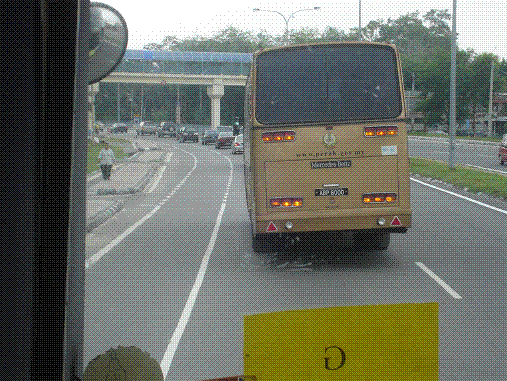 The convoy carrying the remains of Laksamana Muhammad Amin and Ngah Ibrahim en-route from Lumut to Kuala Kangsar via the old road, after the completion of the reception ceremony by the army at the Lumut Naval Base. Here, the 1.5km-long convoy were somewhere in Sitiawan, at about 10.15 am.
 The convoy passing near Kampung Kota main mosque in Beruas at almost 11am. For information, not far behind the mosque are situated tombs of the kings of Beruas of which many are marked with winged-type Aceh gravestones, similar to the ones found on the tomb of Sultan Malikus Salih situated at the former centre of the Samudera-Pasai kingdom in Aceh, also similar to the gravestone at the only remaining tomb of a Malaccan king in Malaysia, that of Sultan Alauddin Riayat Shah at Kampung Raja, Pagoh, Muar... And, almost the spitting image of the gravestones marking the tomb of Perak's first king, Sultan Muzaffar Shah at Telok Bakong, Bota Kanan.
 Convoy arrives at the t-junction of the old Lumut-Ipoh road to head for Kuala Kangsar via Manong at about 11.15.
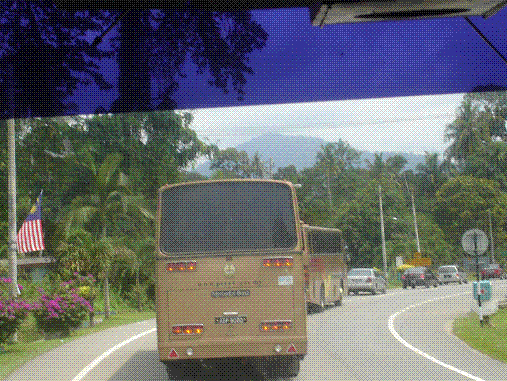 Convoy nears Kuala Kangsar. The time is almost 12 noon...
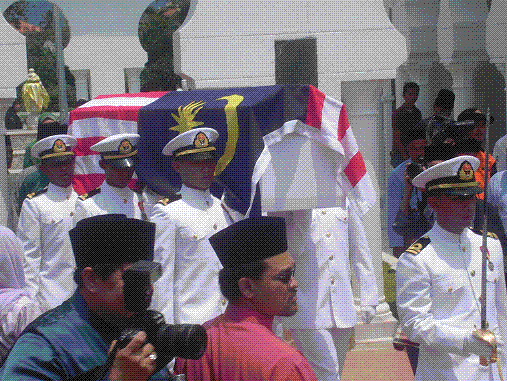 The remains of Laksamana Muhammad Amin ceremoniusly brought into the Perak royal mausoleum area at Bukit Chandan, Kuala Kangsar. The time is about 12.15... Many have converged there including guest, relatives and those who just want to be part of the happenings... Seen at the background is the main mausoleum building housing a few kings of Perak closely related to Sultan Idris I who opened up Bukit Chandan in the early 1900s...
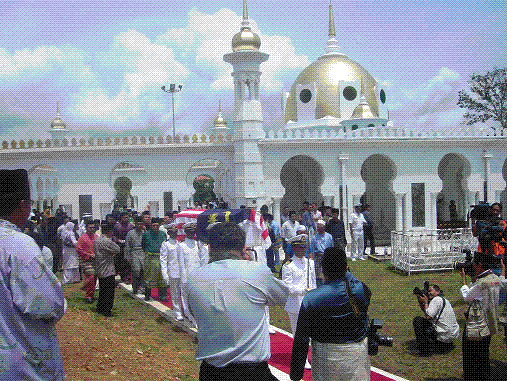 The remains of Laksamana Muhammad Amin brought near the mausoleum area which housed the bodies of the close kins of Sultan Abdullah Muhammad Shah II, the Perak king exiled to the Seychelles Islands in 1877 along with the Laksamana, Shahbandar Uda Ma'amor and Nga Ibrahim for being involved in the murder of the British Resident J.W.W. Birch in 1875. Both Uda Ma'amor and Ngah Ibrahim are Muhammad Amin's son-in-laws while the Laksamana is the third cousin of Sultan Abdullah.
 The navy and those present paying their final respect before the remains are to be lowered down the ground. Seen in the background is part of the Ubudiyah Mosque of Bukit Chandan.
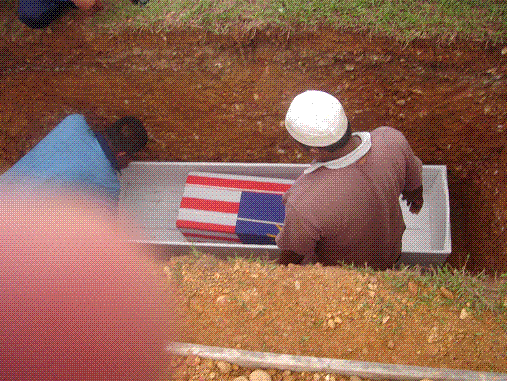 Workers making sure the coffin is put properly in place along with the remains of Laksamana Muhammad Amin inside the special box brought from Singapura.
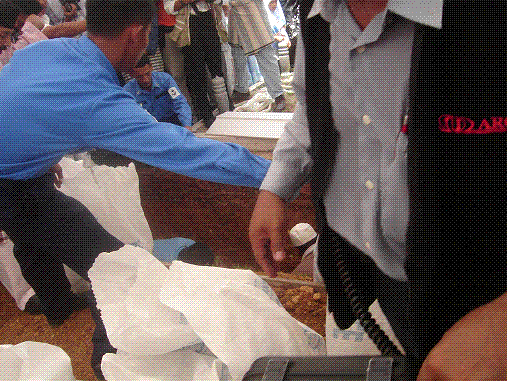 Navy personnel working hard to cover the ground with red earth as prepared while those present watched.
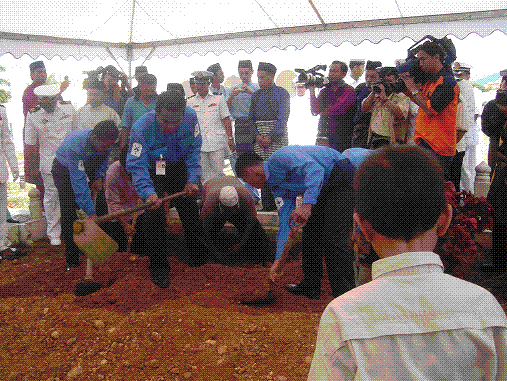 The burial is almost completed
 The remains of Laksamana Muhammad Amin safely buried at Perak's royal mausoleum, Bukit Chandan, Kuala Kangsar. Those present followed the special prayers recited by the imam (prayer congregation leader), forgot to check who he is... Didn't realise the navy can follow the prayer with just one hand? Perhaps it's the way done during war-time?
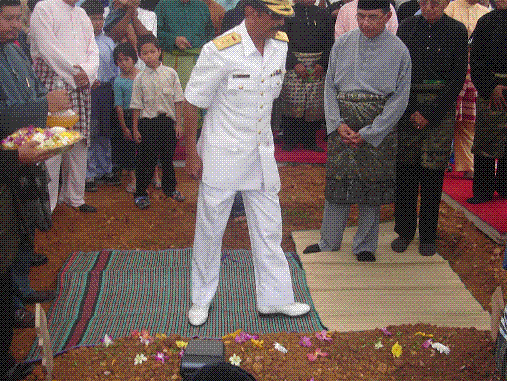 The Raja dihilir of Perak (second in-line to the throne) Raja Jaafar with the poise of an admiral, the king of the sea coming forth to pay his respects while Perak chief minister Tajol Rosli watches on.
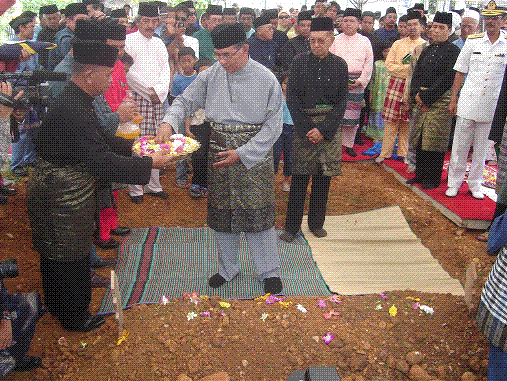 Tajol Rosli's turn to spread the flowers and water the tomb of Laksamana Muhammad Amin... In the picture were many palace people including those related to me but I don't know any of them except one or two.
DONE!
The tale of Keramat Kuala Bidor 2… Touching a bit on the world shadow government
Continued from the previous posting, “The tale of Keramat Kuala Bidor” based on the story in the Malay novel “Berpetualang ke Aceh: Mencari Diri dan Erti”.
At first Rasyid tried to shrug off the weird dream, pretending as if it never ever happened. At that time, he was into his third year as sports journalist and was busy covering all sorts of events and tournaments especially in hockey, equestrian and motorsports. But the September 11 disaster of 2001 which saw the World Trade Centre twin towers in New York crumbling down to dust pulled him back to the dream which happened about a month before. As if there was a strong connection to the disaster which he believed marked an all-out attack by Zionist forces against the Muslim world. And this in turn would spark the Third World War soon enough, all of it in turn connected to the end-time propechies mentioned by the prophet Muhammad SAW 1,400 years ago!
Previously, the guy had studied the document called Protocols of the Elders of Zion which he found by accident while surfing the Internet at the office, a set of protocols which seemed to contain a detailed plan to conquer to world and create a huge world government to be known as The New World Order. The plan which was conceived by Zionist intellectuals from a previous generation also listed wholesale control over all forms of mass media – dailies, all sort of news, articles, radio programmes, TV, entertainment and Hollywood films to shape the kind of apathetic society which is easily manipulated… And this runs along with popular promotion of interest-based economics “sponsored” by the international bankers while political support is given to smart and charismatic budding politicians around the world but with moral faults making them easier to be herded by the Jews.
By then, Rasyid who was starting to get acquinted back to a moral good Muslim life while upholding the compulsory prayers as often as he could have also learned about the Freemason, a group with far-reaching tentacles which prided itself as built on the “correct” principles of universal brotherhood with the good intend of building a noble world-wide civilisation but is in fact an underground machinery created to support the Protocols. The machinery is in turn supported by the Illuminati, an elite group of wealthy and powerful thinkers from all over the world who move hidden in the shadows not unlike the dark figures behind all the webs of lies in the popular TV series the X-Files.
The views and explanations given by Henry Ford, the founder of the giant car-maker in his book The International Jews which detailed the tactics and workings of the Jews to control the early 20th century American economy just serve to plant more firmly his belief on the existence of a detailed Zionist plan to rule the world. His heart told him all these were already implied in the dream he had sometime ago.
For over a week Rasyid was restless with questions asking what is the meaning of this. Why did he felt the Third World War which according to a document on the Illuminati is mentioned as the last well-conceived war before the world could truly be conquered is just around the corner. In fact, maybe the war has already started with September 11… In the same fashion that the First and Second World War which took millions of life started with just small-scale violence somewhere in Eastern Europe before escalating within a few years to cover the whole world.
In the end, the guy couldn’t stand it any more. His instint told him, only Nenek (his father’s mother) could elaborate the meanings behind his weird dream and explain what is happening to him. All this while, he was closer to his mother’s family but nevertheless, he made a point of visiting Nenek at least once a year… Except during his student days in England and the last three years.
God knows how, Rasyid managed to get a weeks’ leave without much questioning. Normally it is very hard to get such a long leave from the sports desk especially when the regional Sea Games of 2001 would be hosted in Kuala Lumpur in a month’s time. And so, after three years of not visiting her, the guy rushed to see Nenek.
Nenek was all welcome and this was apparent the minute he arrived. The 70 plus year-old woman was her usual pleasant self, all smiles with soft lights showing how caring she is radiating from her eyes. And she still likes to wear Kedah traditional blouse along with Batik down her waist. Although her eldest grandchild (Rasyid of course!) have not visited her for ages, Nenek was not the least slighted. In fact the radiance on her face looked much more pleasant than before, as if suggesting she was already expecting his presence.
Muhammad Al-Aminul Rasyid waited after lunch is completed before bringing out what has been troubling his heart for some time… By telling her about the weird dream which involved the Perak Sultanate and its relationship with the end-times. Imagine, after so long not talking to Nenek, in fact never once in his whole life had he showed any interest on the state where his father was born, suddenly out of the blue he appeared and started asking about the old tales of Perak. Surprisingly, Nenek was not perturbed or astonished at all! She was so casual about it, as if it is high time her grandchild knew about his family origin, as if the time has finally arrive for him to take on a certain task… And so Nenek opened up the story…
At first Rasyid tried to shrug off the weird dream, pretending as if it never ever happened. At that time, he was into his third year as sports journalist and was busy covering all sorts of events and tournaments especially in hockey, equestrian and motorsports. But the September 11 disaster of 2001 which saw the World Trade Centre twin towers in New York crumbling down to dust pulled him back to the dream which happened about a month before. As if there was a strong connection to the disaster which he believed marked an all-out attack by Zionist forces against the Muslim world. And this in turn would spark the Third World War soon enough, all of it in turn connected to the end-time propechies mentioned by the prophet Muhammad SAW 1,400 years ago!
Previously, the guy had studied the document called Protocols of the Elders of Zion which he found by accident while surfing the Internet at the office, a set of protocols which seemed to contain a detailed plan to conquer to world and create a huge world government to be known as The New World Order. The plan which was conceived by Zionist intellectuals from a previous generation also listed wholesale control over all forms of mass media – dailies, all sort of news, articles, radio programmes, TV, entertainment and Hollywood films to shape the kind of apathetic society which is easily manipulated… And this runs along with popular promotion of interest-based economics “sponsored” by the international bankers while political support is given to smart and charismatic budding politicians around the world but with moral faults making them easier to be herded by the Jews.
By then, Rasyid who was starting to get acquinted back to a moral good Muslim life while upholding the compulsory prayers as often as he could have also learned about the Freemason, a group with far-reaching tentacles which prided itself as built on the “correct” principles of universal brotherhood with the good intend of building a noble world-wide civilisation but is in fact an underground machinery created to support the Protocols. The machinery is in turn supported by the Illuminati, an elite group of wealthy and powerful thinkers from all over the world who move hidden in the shadows not unlike the dark figures behind all the webs of lies in the popular TV series the X-Files.
The views and explanations given by Henry Ford, the founder of the giant car-maker in his book The International Jews which detailed the tactics and workings of the Jews to control the early 20th century American economy just serve to plant more firmly his belief on the existence of a detailed Zionist plan to rule the world. His heart told him all these were already implied in the dream he had sometime ago.
For over a week Rasyid was restless with questions asking what is the meaning of this. Why did he felt the Third World War which according to a document on the Illuminati is mentioned as the last well-conceived war before the world could truly be conquered is just around the corner. In fact, maybe the war has already started with September 11… In the same fashion that the First and Second World War which took millions of life started with just small-scale violence somewhere in Eastern Europe before escalating within a few years to cover the whole world.
In the end, the guy couldn’t stand it any more. His instint told him, only Nenek (his father’s mother) could elaborate the meanings behind his weird dream and explain what is happening to him. All this while, he was closer to his mother’s family but nevertheless, he made a point of visiting Nenek at least once a year… Except during his student days in England and the last three years.
God knows how, Rasyid managed to get a weeks’ leave without much questioning. Normally it is very hard to get such a long leave from the sports desk especially when the regional Sea Games of 2001 would be hosted in Kuala Lumpur in a month’s time. And so, after three years of not visiting her, the guy rushed to see Nenek.
Nenek was all welcome and this was apparent the minute he arrived. The 70 plus year-old woman was her usual pleasant self, all smiles with soft lights showing how caring she is radiating from her eyes. And she still likes to wear Kedah traditional blouse along with Batik down her waist. Although her eldest grandchild (Rasyid of course!) have not visited her for ages, Nenek was not the least slighted. In fact the radiance on her face looked much more pleasant than before, as if suggesting she was already expecting his presence.
Muhammad Al-Aminul Rasyid waited after lunch is completed before bringing out what has been troubling his heart for some time… By telling her about the weird dream which involved the Perak Sultanate and its relationship with the end-times. Imagine, after so long not talking to Nenek, in fact never once in his whole life had he showed any interest on the state where his father was born, suddenly out of the blue he appeared and started asking about the old tales of Perak. Surprisingly, Nenek was not perturbed or astonished at all! She was so casual about it, as if it is high time her grandchild knew about his family origin, as if the time has finally arrive for him to take on a certain task… And so Nenek opened up the story…
Tuesday, December 05, 2006
The tale of Keramat Kuala Bidor
Below is an initial attempt to translate/adapt parts of the chapter called "Dari Perlak ke Perak: Kisah Keramat Kuala Bidor" (From Perlak to Perak: The tale of Keramat Kuala Bidor)... From the Malay novel "Berpetualang ke Aceh: Mencari Diri dan Erti" - (The trip to Aceh: In search of self and meaning?)... Have a look...
Those studying the old history of Aceh must surely know the name Sultan Malikus Salih, the founder of the twin kingdom of Samudera and Pasai, very famous indeed especially in the annals of Islamic history and the Malay Archipelago. Long before the kingdom of Melaka existed and embraced Islam, his royal highness have made his kingdoms the main centre of Islamic knowledge, transmission and missionary activities of this part of the world.
Tales on this Sultan is immortalised in the old text Hikayat Raja-raja Pasai, considered by scholars and historians as the oldest Malay text available. His tomb in Aceh invites many who wants to get acquainted with Islamic civilization of yore. But how many knew his royal highness and the kingdoms would never have existed if not for a certain figure who used to live at Teluk Intan and died there? How many even realise the connection between the Sultan this particular Perak man?
Its just this man’s tomb is alienated inside a palm oil estate, unlike the prominent tomb of Malikus Salih in Sumatera which is marked by Aceh tombstones, symbolising the high status of the person. The one in Perak is only marked with stones picked from the river, enough to show there once existed a certain person who walked on this earth, once upon a time.
What shows this man is not just not any Tom, Dick and Harry is the yellow clothes tied to the stones, marking him as of royal prominence with saintly powers. And thus he was known as the Keramat Kuala Bidor, literally translated, the saintly person of Kuala Bidor (referring to the estuary of the Bidor river where he used to live).
……………
Rasyid came to know of the existence of Keramat Kuala Bidor when he was moved to search from Nenek (his grandma) some old stories regarding Perak. Before this, he had not the slightest interest in such stories, having been branded by his own family of being too Westernised… Maybe because of his four years of study in London sometime ago?
Muhammad Al Aminul Rasyid used to be very proud of his God-given intellectual capacity to digest Western studies like the philosopies of Socrates and Plato. And thus Western ideological texts such as the Das Kapital and Communist Manifesto of Karl Marx, Wealth of Nations by Adam Smith and of course, The Prince by Nicolo Machiavelli, the Italian political strategist known for the quote “the ends justify the means” which has become a mantra for politicians became his daily diet.
The guy also happens to have “Western features”. If his younger days in primary school saw him being ashamed of his clear white-reddish complexion plus his rather brownish hair, the tables are turned during his youth. His natural looks which used to be reasons for others to take a pick and make jokes on him became assets instead as the girls began to show interest… And all this happened while many Malay guys were trying to find ways to smoothen and withen their skin and paint their hair in lighter shade to look like Westerners and so be deemed fairer and more good-looking.
Rasyid really enjoyed his assets as more and more girls especially the really good-looking ones praise his “Western” looks, although as far as family history shows, he has not a shred of European or Western blood. And so the Muar, Johor-born lad became sure there was no need to know anything about old Malay folklore and tales… Although he used to really loved it when he was small with local tales like Hikayat Merong Mahawangsa and Hikayat Inderaputra receiving as much interest as the tales of Greek Gods like Zeus and Aphrodite, also the Norse Gods like Odin, Thor and Loki… After all he loves stories with mythical themes and magic in it.
The guy only change his stance when a sort of “Malayness” feeling began to permeate his being, a kind of a bitter-sweet feeling “activated” when he first heard a collection of songs on the CD written by M.Nasir but sung by Hattan particularly the one titled “Lagu Cenderawasih”. This particular song has some sort of mystical tinge to it, at least that’s what he felt upon hearing it one early morning while cleaning the chimneys alone at a Malay restaurant in London. It was in 1995 and Rasyid was in his final year of his Degree in Mathematics. But he had to take a few odd jobs including rearranging the books at the university library, serving customers and cleaning the pots and pans at the University of London Union cafetaria and handing leaflets in front of Dillon’s bookstore nearby to make ends meet after his scholarship was discontinued for breaking the contract.
Too bad, when he returned to Malaysia, he was soon immersed back in Westernised activities which set aside good Islamic and Malay norms. His job as a journalist attached to a prominent English daily often made him lost in enjoyment at prestigious functions and parties… The kind with free mixing accentuated by really sexy and glamorous ladies egged on further by what seemed to be never-ending supply of liquor and beer. Imagine, exclusive Formula One parties at the best night-clubs in town attended only by a list of who’s who… With model-type ladies (waif, alluring, plenty of smiles and ready for action) which one normally found at motor-races to take care of guests, courtesy of the big companies eager to make journalists very happy in exchange for perpetual publicity. Who would ever thought, one day, after spending so much happy-go-lucky time in this Internet age and free-for-all information world, Rasyid had a dream which would force him to study old Perak tales and then on Aceh and anything to do with it? Who would have thought it would go on until this book, a rather weird piece of writing materialised and is now sitting right in front of your face?
Those studying the old history of Aceh must surely know the name Sultan Malikus Salih, the founder of the twin kingdom of Samudera and Pasai, very famous indeed especially in the annals of Islamic history and the Malay Archipelago. Long before the kingdom of Melaka existed and embraced Islam, his royal highness have made his kingdoms the main centre of Islamic knowledge, transmission and missionary activities of this part of the world.
Tales on this Sultan is immortalised in the old text Hikayat Raja-raja Pasai, considered by scholars and historians as the oldest Malay text available. His tomb in Aceh invites many who wants to get acquainted with Islamic civilization of yore. But how many knew his royal highness and the kingdoms would never have existed if not for a certain figure who used to live at Teluk Intan and died there? How many even realise the connection between the Sultan this particular Perak man?
Its just this man’s tomb is alienated inside a palm oil estate, unlike the prominent tomb of Malikus Salih in Sumatera which is marked by Aceh tombstones, symbolising the high status of the person. The one in Perak is only marked with stones picked from the river, enough to show there once existed a certain person who walked on this earth, once upon a time.
What shows this man is not just not any Tom, Dick and Harry is the yellow clothes tied to the stones, marking him as of royal prominence with saintly powers. And thus he was known as the Keramat Kuala Bidor, literally translated, the saintly person of Kuala Bidor (referring to the estuary of the Bidor river where he used to live).
……………
Rasyid came to know of the existence of Keramat Kuala Bidor when he was moved to search from Nenek (his grandma) some old stories regarding Perak. Before this, he had not the slightest interest in such stories, having been branded by his own family of being too Westernised… Maybe because of his four years of study in London sometime ago?
Muhammad Al Aminul Rasyid used to be very proud of his God-given intellectual capacity to digest Western studies like the philosopies of Socrates and Plato. And thus Western ideological texts such as the Das Kapital and Communist Manifesto of Karl Marx, Wealth of Nations by Adam Smith and of course, The Prince by Nicolo Machiavelli, the Italian political strategist known for the quote “the ends justify the means” which has become a mantra for politicians became his daily diet.
The guy also happens to have “Western features”. If his younger days in primary school saw him being ashamed of his clear white-reddish complexion plus his rather brownish hair, the tables are turned during his youth. His natural looks which used to be reasons for others to take a pick and make jokes on him became assets instead as the girls began to show interest… And all this happened while many Malay guys were trying to find ways to smoothen and withen their skin and paint their hair in lighter shade to look like Westerners and so be deemed fairer and more good-looking.
Rasyid really enjoyed his assets as more and more girls especially the really good-looking ones praise his “Western” looks, although as far as family history shows, he has not a shred of European or Western blood. And so the Muar, Johor-born lad became sure there was no need to know anything about old Malay folklore and tales… Although he used to really loved it when he was small with local tales like Hikayat Merong Mahawangsa and Hikayat Inderaputra receiving as much interest as the tales of Greek Gods like Zeus and Aphrodite, also the Norse Gods like Odin, Thor and Loki… After all he loves stories with mythical themes and magic in it.
The guy only change his stance when a sort of “Malayness” feeling began to permeate his being, a kind of a bitter-sweet feeling “activated” when he first heard a collection of songs on the CD written by M.Nasir but sung by Hattan particularly the one titled “Lagu Cenderawasih”. This particular song has some sort of mystical tinge to it, at least that’s what he felt upon hearing it one early morning while cleaning the chimneys alone at a Malay restaurant in London. It was in 1995 and Rasyid was in his final year of his Degree in Mathematics. But he had to take a few odd jobs including rearranging the books at the university library, serving customers and cleaning the pots and pans at the University of London Union cafetaria and handing leaflets in front of Dillon’s bookstore nearby to make ends meet after his scholarship was discontinued for breaking the contract.
Too bad, when he returned to Malaysia, he was soon immersed back in Westernised activities which set aside good Islamic and Malay norms. His job as a journalist attached to a prominent English daily often made him lost in enjoyment at prestigious functions and parties… The kind with free mixing accentuated by really sexy and glamorous ladies egged on further by what seemed to be never-ending supply of liquor and beer. Imagine, exclusive Formula One parties at the best night-clubs in town attended only by a list of who’s who… With model-type ladies (waif, alluring, plenty of smiles and ready for action) which one normally found at motor-races to take care of guests, courtesy of the big companies eager to make journalists very happy in exchange for perpetual publicity. Who would ever thought, one day, after spending so much happy-go-lucky time in this Internet age and free-for-all information world, Rasyid had a dream which would force him to study old Perak tales and then on Aceh and anything to do with it? Who would have thought it would go on until this book, a rather weird piece of writing materialised and is now sitting right in front of your face?
Thursday, November 30, 2006
The Malay Annals
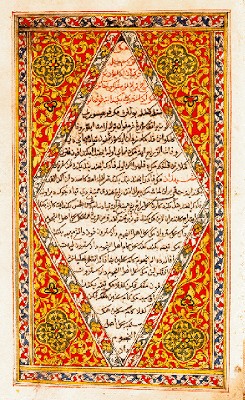 Just something I've found on the Internet which happens to be on a subject I'm very interested in... Malay olden history. This one talks about an old Malay text almost 400 years old which happens to be one of the main source of old Malay history. So have a go!
Sejarah Melayu
The Malay Annals
The Sejarah Melayu (Malay Annals) is clearly the most famous, distinctive and best classical Malay prose to be ever produced, sharing in the great literary tradition other Malay works such as the Hikayat Hang Tuah, Hikayat Raja-Raja Pasai and the Hikayat Marong Mahawangsa (Kedah Annals).
It chronicles the establishment of the Malaccan sultanate, charting a course of more than 600 years in a solid compact book filled with intricate details regarding royal protocol, royal lineages, weaving in various historical, mythical and legendary figures and episodes in a compendium that still captivates its audiences three centuries later. Not historically connected, the collection of stories focuses on the activities of the Melaka sultans, their ancestors, their courts, government officials, allies and enemies. Certainly, foreign rulers were also described, as were Malacca's foreign relations and its importance as a regional trading centre. A noteworthy omission was the absence of any mention of peasant life.
Attributed to Tun Seri Lanang as its first editor, the work was commissioned by Sultan 'Ala'u-d-din Ri'ayat Shah of Johor. It was claimed to have been begun in on Sunday May 13, 1612, in Pasai, Sumatra, where the Sultan was being held captive Mahkota Alam of Acheh. However, some scholars think that the original text was written prior to 1536 and underwent changes in 1612.
Scholars agree that its well-written narrative and characterisation of personalities makes it a world-class literary classic. Like any literary work of the medieval age, it has its downright boring moments - the endless geneaologies of rulers, every girl must be of peerless beauty, no army or fleet numbers less than "the thousands past counting".... But, on the other hand, the sheer narrative power is electric in many passages. It is most brilliant when the author admires the cunning (cherdek) of the peoples of the peninsula - time after time, the "men of Melaka" are just too clever for the foreigner and there is sheer artistry, wit and humour when the author has his gentle digs at the foreigner (gunting makan di-hujung!). Tales abound of the Melaka men (and women) outwitting, outflanking and befuddling all and sundry - from the Emperor of China to the largest Siamese fleets.
It is also an important historical source about Malacca and the Malay world prior to Malacca's defeat by the Portuguese in 1511. Although the Sejarah Melayu mentions only one date, events described in it can be verified by other historical sources. Much of the material found on this website is derived from the Sejarah.
However, the main aim of this work was, undoubtedly, to laud the spleandour, greatness and superiority of the Melaka Sultanate - and it was written at a time when the Johor court, successors of the Melaka sultans, were being attacked by Portuguese and Achinese, their capital sacked many times and having to be moved from one part of the Straits to another. The court was frequently on the run from marauding invaders, their territories being overrun. The Sejarah Melayu was probably an attempt by the Johor court to overcome its sense of lost fortunes by regaining the past glories of a mythical golden age that was less than a generation past. It still serves to inspire the Malay of today - and to remind them of the heights that they can be, and have been, capable of reaching.
Holding infinity in your hands

For reasons I can't figure out, I suddenly got the urge to post this famous poem. So here goes...
William Blake - Auguries of Innocence
To see a world in a grain of sand,
And a heaven in a wild flower,
Hold infinity in the palm of your hand,
And eternity in an hour.
A robin redbreast in a cage
Puts all heaven in a rage.
A dove-house fill'd with doves and pigeons
Shudders hell thro' all its regions.
A dog starv'd at his master's gate
Predicts the ruin of the state.
A horse misused upon the road
Calls to heaven for human blood.
Each outcry of the hunted hare
A fibre from the brain does tear.
A skylark wounded in the wing,
A cherubim does cease to sing.
The game-cock clipt and arm'd for fight
Does the rising sun affright.
Every wolf's and lion's howl
Raises from hell a human soul.
The wild deer, wand'ring here and there,
Keeps the human soul from care.
The lamb misus'd breeds public strife,
And yet forgives the butcher's knife.
The bat that flits at close of eve
Has left the brain that won't believe.
The owl that calls upon the night
Speaks the unbeliever's fright.
He who shall hurt the little wren
Shall never be belov'd by men.
He who the ox to wrath has mov'd
Shall never be by woman lov'd.
The wanton boy that kills the fly
Shall feel the spider's enmity.
He who torments the chafer's sprite
Weaves a bower in endless night.
The caterpillar on the leaf
Repeats to thee thy mother's grief.
Kill not the moth nor butterfly,
For the last judgement draweth nigh.
He who shall train the horse to war
Shall never pass the polar bar.
The beggar's dog and widow's cat,
Feed them and thou wilt grow fat.
The gnat that sings his summer's song
Poison gets from slander's tongue.
The poison of the snake and newt
Is the sweat of envy's foot.
The poison of the honey bee
Is the artist's jealousy.
The prince's robes and beggar's rags
Are toadstools on the miser's bags.
A truth that's told with bad intent
Beats all the lies you can invent.
It is right it should be so;
Man was made for joy and woe;
And when this we rightly know,
Thro' the world we safely go.
Joy and woe are woven fine,
A clothing for the soul divine.
Under every grief and pine
Runs a joy with silken twine.
The babe is more than swaddling bands;
Every farmer understands.
Every tear from every eye
Becomes a babe in eternity;
This is caught by females bright,
And return'd to its own delight.
The bleat, the bark, bellow, and roar,
Are waves that beat on heaven's shore.
The babe that weeps the rod beneath
Writes revenge in realms of death.
The beggar's rags, fluttering in air,
Does to rags the heavens tear.
The soldier, arm'd with sword and gun,
Palsied strikes the summer's sun.
The poor man's farthing is worth more
Than all the gold on Afric's shore.
One mite wrung from the lab'rer's hands
Shall buy and sell the miser's lands;
Or, if protected from on high,
Does that whole nation sell and buy.
He who mocks the infant's faith
Shall be mock'd in age and death.
He who shall teach the child to doubt
The rotting grave shall ne'er get out.
He who respects the infant's faith
Triumphs over hell and death.
The child's toys and the old man's reasons
Are the fruits of the two seasons.
The questioner, who sits so sly,
Shall never know how to reply.
He who replies to words of doubt
Doth put the light of knowledge out.
The strongest poison ever known
Came from Caesar's laurel crown.
Nought can deform the human race
Like to the armour's iron brace.
When gold and gems adorn the plow,
To peaceful arts shall envy bow.
A riddle, or the cricket's cry,
Is to doubt a fit reply.
The emmet's inch and eagle's mile
Make lame philosophy to smile.
He who doubts from what he sees
Will ne'er believe, do what you please.
If the sun and moon should doubt,
They'd immediately go out.
To be in a passion you good may do,
But no good if a passion is in you.
The whore and gambler, by the state
Licensed, build that nation's fate.
The harlot's cry from street to street
Shall weave old England's winding-sheet.
The winner's shout, the loser's curse,
Dance before dead England's hearse.
Every night and every morn
Some to misery are born,
Every morn and every night
Some are born to sweet delight.
Some are born to sweet delight,
Some are born to endless night.
We are led to believe a lie
When we see not thro' the eye,
Which was born in a night to perish in a night,
When the soul slept in beams of light.
God appears, and God is light,
To those poor souls who dwell in night;
But does a human form display
To those who dwell in realms of day.
Tuesday, November 28, 2006
The reason behind the fall of Melaka
Often the Malays, in fact the whole world are told the kingdom of Melaka (the West like to spell it as Malacca), a very important Malay kingdom which dominated the Eastern part of the world in the 15th Century was conquered by the Portuguese in 1511 AD because they lack modern firepower. The Portuguese were supposed to represent the "more advanced" Western culture while Melaka was supposed to be backward in every way and thus was ripe picking for the day. Is that truly the case or is there something the so called academic historians (which happens to represent the Western Occidental view of the world) fail to take note?
Here is an alternative view taken from the Malay novel "Berpetualang ke Aceh: Mencari Diri dan Erti". The translation (and/or adaptation) below follows from a story on how the brave king Sultan Alauddin Riayat Shah was actually betrayed by his own noblemen and forced to exile himself somewhere far from the court of Melaka. And thus his adult son Raja Munawar was sidelined from the throne, instead the prince's half-brother who was still a baby was promoted as the king Sultan Mahmud with the nobles actually in charge.
Sultan Mahmud grew up to be spoilt brat who made impossible demands on his people. It is within this unhealthy climate that city of Melaka finally fell to the West. Here is the story from the novel...
Have you ever sincerely ask, why the city of Melaka which the West called "The Venice of the East" can be conquered so easily? Wasn't it noted by many as the most affluent city in this part of the world at that time? And in order to protect it, didn't Melaka had a great army including the biggest and most advanced naval force in the Malay world? So how could it fell to the Portuguese who according to the stories came with only a few ships? Is it possible Melaka is that weak?
Official history often say Melaka was conquered because the modern war equipments of Portuguese hold sway over the ancient ones of the Malays. They had high-powered cannons, pistols, armour and shield made from iron while the Malays allegedly depended only on spears, swords and keris (a special Malay blade)... And the Malays were wearing the soft Malay traditional clothes which can be easily penetrated... Unlike the Portuguese whose iron-made war-clothings were practically indestructible. So of course it's natural for the Malays to lose isn't it given the "fact" they are backward and behind the times?
But do ask yourself sincerely and with an open mind. Is it possible, Melaka which at that time have received visitors and traders from big and advanced civilisations like the Islamic Empire in the Middle East, China and India can be so backward? They have long established diplomatic ties with kingdoms which were far more advanced that the West of the time. Is it acceptable the Malays don't understand the strategic needs to protect a port city which is practically the jugular vein of the Malay world, in fact the whole world? Can the Malays be so stupid and backward?
.................
"Nay! Melaka didn't fall because the Malays were behind the times," Rasyid (the main character in the book) argues like a champion of his people in front some acquiantance. “For a long time Melaka had cannons and pistols which can be bought from the Middle East of China and knew iron-clad armour. In fact I’m confident the Malays already knew how to produce all these war equipments themselves. Do you actually think the Malays are so stupid?”
“Meanwhile, those who choose to fight using keris, spears and such were no mere fighters,” he continued. “It’s not that they never saw modern weapons or their thinking backward, it’s just believe it or not, they have certain ways to beat these weapons.”
The Melaka naval force which routinely patrolled the whole length of the Straits of Melaka, the world’s busiest trade route till now, was noted for its efficiency. Under the leadership of such illustrious figures like the Bendahara (something like the Prime Minister) Tun Perak and Admiral Hang Tuah, it had succesfully foiled attacks from Siam and any hostile forces.
“Isn’t it big and strong enough to ensure the safety of the populace, visitors and traders along the length of the Straits of Melaka?” Rasyid asks. “After all, the Melaka navy controlled the route from the uppermost northern parts of the Peninsula until down south near the island of Java, observing and able to sniff out any hostile activities before the enemy can go anywhere near the administrative centre at the city of Melaka?”
So how come Melaka did fall? And even more perplexing, where were the local navy when the city was attacked? A golden question which had many of his acquaintances totally dumb-founded and at lost for words.
“Go and read any literature on the fall of Melaka including the lop-sided Western accounts,” the guy now challenges. “The navy was nowhere in sight allowing the city to be pounded by Portuguese cannons from the sea. Not a single ship from Melaka tried to stop them, there were no obstacle at all to stop the enemy from advancing. Isn’t this strange?”
This should be enough food for thought isn’t it?
“Well. This is what happens when a stupid and irrational king is raised to the throne while corrupt officials hold sway over the nation,” Rasyid went on. “Those with real capabilities were sidelined while the remaining officials with clout became disillusioned. So how can the defence mechanism be employed to the fullest? Maybe the people of Melaka themselves were ready to change sides and barter their loyalty along with the foreign traders? Or maybe for a long time, there already exist traitors within the ranks just biding their time and that’s why the Melaka navy were rendered useless?”
Now, there are some old accounts from some Malay old folks saying most of the ships which attacked Melaka were not even Portuguese but were Malay-owned, in fact coming from the Melaka navy! Rasyid had also read somewhere, there was a Portuguese account saying they saw an armada which was recognisable as belonging to the Malays being prepared for seige somewhere along the Straits of Melaka. Maybe its true what the rumours say… That Tun Mutahir (the Bendahara alias Prime Minister executed by the king of the time on charge of treason) was making preparations to seize the throne or maybe there were other parties planning this but accused the Bendahara of doing so? Whatever, there sure were traitors in the fold.
Here is an alternative view taken from the Malay novel "Berpetualang ke Aceh: Mencari Diri dan Erti". The translation (and/or adaptation) below follows from a story on how the brave king Sultan Alauddin Riayat Shah was actually betrayed by his own noblemen and forced to exile himself somewhere far from the court of Melaka. And thus his adult son Raja Munawar was sidelined from the throne, instead the prince's half-brother who was still a baby was promoted as the king Sultan Mahmud with the nobles actually in charge.
Sultan Mahmud grew up to be spoilt brat who made impossible demands on his people. It is within this unhealthy climate that city of Melaka finally fell to the West. Here is the story from the novel...
Have you ever sincerely ask, why the city of Melaka which the West called "The Venice of the East" can be conquered so easily? Wasn't it noted by many as the most affluent city in this part of the world at that time? And in order to protect it, didn't Melaka had a great army including the biggest and most advanced naval force in the Malay world? So how could it fell to the Portuguese who according to the stories came with only a few ships? Is it possible Melaka is that weak?
Official history often say Melaka was conquered because the modern war equipments of Portuguese hold sway over the ancient ones of the Malays. They had high-powered cannons, pistols, armour and shield made from iron while the Malays allegedly depended only on spears, swords and keris (a special Malay blade)... And the Malays were wearing the soft Malay traditional clothes which can be easily penetrated... Unlike the Portuguese whose iron-made war-clothings were practically indestructible. So of course it's natural for the Malays to lose isn't it given the "fact" they are backward and behind the times?
But do ask yourself sincerely and with an open mind. Is it possible, Melaka which at that time have received visitors and traders from big and advanced civilisations like the Islamic Empire in the Middle East, China and India can be so backward? They have long established diplomatic ties with kingdoms which were far more advanced that the West of the time. Is it acceptable the Malays don't understand the strategic needs to protect a port city which is practically the jugular vein of the Malay world, in fact the whole world? Can the Malays be so stupid and backward?
.................
"Nay! Melaka didn't fall because the Malays were behind the times," Rasyid (the main character in the book) argues like a champion of his people in front some acquiantance. “For a long time Melaka had cannons and pistols which can be bought from the Middle East of China and knew iron-clad armour. In fact I’m confident the Malays already knew how to produce all these war equipments themselves. Do you actually think the Malays are so stupid?”
“Meanwhile, those who choose to fight using keris, spears and such were no mere fighters,” he continued. “It’s not that they never saw modern weapons or their thinking backward, it’s just believe it or not, they have certain ways to beat these weapons.”
The Melaka naval force which routinely patrolled the whole length of the Straits of Melaka, the world’s busiest trade route till now, was noted for its efficiency. Under the leadership of such illustrious figures like the Bendahara (something like the Prime Minister) Tun Perak and Admiral Hang Tuah, it had succesfully foiled attacks from Siam and any hostile forces.
“Isn’t it big and strong enough to ensure the safety of the populace, visitors and traders along the length of the Straits of Melaka?” Rasyid asks. “After all, the Melaka navy controlled the route from the uppermost northern parts of the Peninsula until down south near the island of Java, observing and able to sniff out any hostile activities before the enemy can go anywhere near the administrative centre at the city of Melaka?”
So how come Melaka did fall? And even more perplexing, where were the local navy when the city was attacked? A golden question which had many of his acquaintances totally dumb-founded and at lost for words.
“Go and read any literature on the fall of Melaka including the lop-sided Western accounts,” the guy now challenges. “The navy was nowhere in sight allowing the city to be pounded by Portuguese cannons from the sea. Not a single ship from Melaka tried to stop them, there were no obstacle at all to stop the enemy from advancing. Isn’t this strange?”
This should be enough food for thought isn’t it?
“Well. This is what happens when a stupid and irrational king is raised to the throne while corrupt officials hold sway over the nation,” Rasyid went on. “Those with real capabilities were sidelined while the remaining officials with clout became disillusioned. So how can the defence mechanism be employed to the fullest? Maybe the people of Melaka themselves were ready to change sides and barter their loyalty along with the foreign traders? Or maybe for a long time, there already exist traitors within the ranks just biding their time and that’s why the Melaka navy were rendered useless?”
Now, there are some old accounts from some Malay old folks saying most of the ships which attacked Melaka were not even Portuguese but were Malay-owned, in fact coming from the Melaka navy! Rasyid had also read somewhere, there was a Portuguese account saying they saw an armada which was recognisable as belonging to the Malays being prepared for seige somewhere along the Straits of Melaka. Maybe its true what the rumours say… That Tun Mutahir (the Bendahara alias Prime Minister executed by the king of the time on charge of treason) was making preparations to seize the throne or maybe there were other parties planning this but accused the Bendahara of doing so? Whatever, there sure were traitors in the fold.
Thursday, November 23, 2006
Achaemenid Empire (648 BCE–330 BCE)
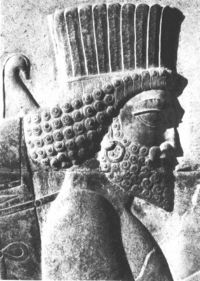
I don't know why but suddenly I got the urge to share this information on the Achaemenid Empire, an ancient empire which flourished around 2,500 years ago and centred inside present-day Iran but with such huge borders covering parts of Europe, Africa and Asia including Greece and of course the whole expanse of land used to be known as Persia up to major parts of India. It was so huge that some believed the Achaemenid king Cyrus the Great is the real Iskandar Zulkarnain, a great king and conqueror mentioned in the Muslim holy book, the Al-Quran as the wise ruler of the East and West.
Now, plenty of scholars believe that Iskandar Zulkarnain in the Quran and the well-known Alexander the Great of Macedonia, the pride of antiquated Europe and a hero of early Western exploits are the same person. So which one is the true Iskandar? Cyrus who built his empire around 550 BC or Alexander who flaunted his greatness at around 330 BC?
The funny thing is, when Alexander beat the last Achaemenid king Darius III and annexed the Persian empire, the scope of land within his conquest looked almost the same as those ruled by Cyrus... Is this a mere conincidence or is there a deeper meaning behind this? Take note, there are those who believe that Alexander the Great is actually a descendant of Cyrus the Great... From a branch of the Achaemenid royal family who were denied the Persian throne and forced into exile until they reappeared in Macedonia... Perhaps that explains why Alexander's family wanted so much to beat and conquer the Persians? Perhaps...
Anyway have a look at this information on the Achaemenid Empire copied from the Wikipedia on-line encyclopaedia -
The Achaemenid dynasty (Old Persian:Hakamanishiya, Persian: هخامنشیان) - was a dynasty in the ancient Persian Empire. At the height of their power, around 500 BC, the Achaemenid rulers of Persia ruled over territories roughly encompassing parts of today's Iran, Iraq, Armenia, Afghanistan, Turkey, Bulgaria, small part of Greece, Egypt, Syria, much of what is now Pakistan, Jordan, Israel/Palestine, Lebanon, Caucasia, Central Asia, Arabia, Libya and north western Indian subcontinent.
Darius the Great (Darius I) was the first to speak of Achaemenes, who he claimed was an ancestor of Cyrus the Great (Cyrus II), ca. 576 - 529 BC), and therefore the progenitor of the entire line of Achaemenid rulers. However, some scholars hold that Achaemenes was a fictional character used to legitimize Darius' rule, and that Darius I usurped the Persian throne. In any case, the name Achaemenid has been commonly accepted for the line of Persian kings beginning at least with Darius I. When the name refers to the entire line of early Persian rulers, including Cyrus II and his son Cambyses, the Achaemenid era stretches from about 650 to 330 BC.
At different times, the Achaemenids also ruled Egypt, although the Egyptians twice regained their independence from Persia. After the practice of Manetho, Egyptian historians refer to the period in Egypt when the Achaemenid dynasty ruled as the Twenty-Seventh (525 BC - 404 BC) and Thirty-First Dynasties (343- 332 BC).
The last Achaemenid king was Darius III (336 BC - 330 BC), who was defeated by Alexander III of Macedon. After the Macedonian conquest, the Persian Empire was annexed by Alexander.
The founder of this dynasty was supposedly Achaemenes (Old Persian Haxāmaniڑ "Of Friendly Mind"). He was succeeded by his son Teispes (Ciڑpi), who first took the title King of Anڑān after seizing that city from the Elamites. Inscriptions indicate that when Teispes died, two of his sons shared the throne as Cyrus I (Kyrush), king of Anڑān, and Ariaramnes (Ariyāramna "Having the Iranians at Peace"), king of Parsua (later called Pārsa "Persia", hence Fārsi, the native name for modern Persian). They were succeeded by their respective sons Cambyses I of Anshan (Kambūjiya, "the Elder"), and Arsames (Arڑāma "Having a Hero's Might") of Persia.
In 559 BC, Cambyses I the Elder was succeeded as king of Anڑān by his son Cyrus II the Great, who also succeeded the still-living Arsames as King of Persia, thus reuniting the two realms. Cyrus II is considered to be the first king of the Achaemenid dynasty to be properly called so, as his predecessors were subservient to Media. Cyrus II conquered Media, Lydia and Babylon.
His successors were less successful. Cyrus' unstable son Cambyses II conquered Egypt, but died in July 522 BC as the result of either accident or suicide, during a revolt led by a priest, Gaumata. Gaumata usurped the throne by pretending to be Smerdis (Pers. Bardiya; Cambyses' brother whom he had secretly had assassinated in 525, before starting out for his Egyptian campaign) until he was overthrown in 522 BC by a member of a lateral branch of the Achaemenid family, Darius I (Old Persian Dārayawuڑ "Who Holds Firm the Good", also known as Darayarahush or Darius the Great).
According to Herodotus, the native leadership then debated the best form of government for the Empire. He reports that it was decided that oligarchy would divide them against one another, and democracy would bring about mob rule resulting in a charismatic leader resuming the monarchy. Therefore, they decided a new monarch was in order, particularly since they were in a position to choose him. Darius I was chosen monarch from amongst the leaders. He was cousin to Cambyses II and Smerdis, claiming Ariaramnes as his ancestor.
Darius attacked the Greek mainland, which had supported rebellious Greek colonies under his aegis; but as a result of his defeat at the Battle of Marathon in 490, he was forced to retract the limits of the empire to Asia Minor.
The Achaemenids thereafter consolidated areas firmly under their control. It was Cyrus and Darius who, by sound and farsighted administrative planning, brilliant military maneuvering, and a humanistic worldview, established the greatness of the Achaemenids and in less than thirty years raised them from an obscure tribe to a world power.
Achaemenid rulers
Teispes of Anshan, son of Achaemenes †
Cyrus I of Anshan, son of Teispes †
Ariaramnes of Persia, son of Teispes and co-ruler with Cyrus I †
Cambyses I of Anshan, son of Cyrus I †
Arsames of Persia, son of Ariaramnes and co-ruler with Cambyses I †
Cyrus II, the Great, son of Cambyses I, ruled from c.550–530 BC (ruler of Anshan c. 559 BC – conquered Media 550 BC)
Macedonian conquest of the Achamenid Empire in 330 BC
Tuesday, November 21, 2006
Experience with orang Asli
Hmm... Suddenly I feel like sharing one more of my old articles from The New Straits Times. Have a look... Cheers!
Publication :
NST-LTIMES
Edition :
2*
Date :
30/10/1997
Page Number :
10
Headline :
Straddling rural and modern life
Words :
1077
Byline :
By Radzi Sapiee
Text :
DEEP in the haze-free hills of the Perak jungle are the Temiars, who make up the main portion of the State's Orang Asli. Clustered in small kampungs throughout the jungle, they live a
precarious existence, balancing between the demands of the modern world and a rustic jungle life.
My first encounter with these shy but friendly people was at Kampung Tonggang, a few kilometres from Tanjung Rambutan. I was part of a 50 four-wheel-drive convoy for the recent National 4x4 Challenge. From Ipoh, we drove past Hospital Bahagia before turning right into a
riverside logging track, twisting and turning into an uphill route before arriving at the kampung, which was on top of a hill.
We were greeted by smiling kampung folks, young and old, already gathered at the open area in front of the main gate, clearly excited at having so many visitors, including Perak Menteri Besar Tan Sri Ramli Ngah Talib, who was with our convoy. A festive mood was in the air as the Temiars, sporting their best clothes, simple and rural by city standards, and garlands on their head ushered us into the biggest hut there, the community hall where traditional dishes - petai, ikan bakar and umbut bayas - awaited.
The visit was capped by the sewang, a traditional dance accompanied by traditional percussion, a set of bamboo sticks hammered in a rap-like beat on a log, and a song in their language, which managed to get some of the visitors, including Ramli, to dance on the bamboo floor.
However, the brief visit did not give me a chance to get to know them better. As it was also an official visit by the Menteri Besar, they were understandably showing their best form, which was perhaps not reflective of their daily lives.
Still, from their clothing - the men in simple baju Melayu and women in batik and T-shirt - and Ramli's pledge that he would introduce more amenities such as public telephones into the kampung, one can gather that they were eager to embrace civilisation as we know it, although preferring to stay near the jungle.
I had to wait for the next day to get a better insight into the Orang Asli attitude towards modernity, this time at another settlement in Pos Poi, some 50km from the nearest town of Sungei Siput. Sitting on the banks of nearby Sungei Piah, some friends and me were enjoying a smoke when a group of six young Temiars in school uniform appeared at the opposite side before stepping into the water.
Keeping their clothes above water level - the boys' blue trousers folded up to their knees while the girls' long skirts held at the tips - they waded across the stream, avoiding the deep end.
Their books held on their head or tucked under the arms, they soon put on their socks and shoes and made their way to Sekolah Kebangsaan Pos Poi, where the rest of the National 4x4 Challenge members had camped for the night.
It was not long before a boy was seen walking half-naked through the stream with only his white shirt on, his face puzzled by the onlookers, including the TV3 camera crew who quickly switched on its camera to get the rare footage of a teenager raring to go to school despite the watery
obstacle. Upon reaching the sandy banks, he got into his trousers and shoes and
coolly walked to the nearby school.
But not everyone is as eager to go to school as these youngsters. A teacher, who wants to be known as Cikgu Ahmad, said out of the 126 pupils registered there, slightly more than half attend classes regularly.
"Some question the virtue of education, saying it did not provide them with any tangible means of getting food," he said.
Instead, they preferred to join their parents to hunt monkeys, birds and other small animals, abundant in the jungle that is their home, following the footsteps of their grandparents and those before them.
However, they were not totally immune from the trappings of the outside world as shown by the T-shirts, bearing pictures of popular Western rock groups, worn by some of the youngsters.
According to village elder Abus Yong, 60, many teenagers work for timber companies operating in the surrounding forest or find menial jobs in small towns such as Sungei Siput to get enough money to sample city life.
"It's kind of a balance. We sometimes go and join the mainstream public. At times, we go hunting in the jungle," he said, exhaling smoke from his kretek cigarette.
While students of Pos Poi had to wade to school, those at Kampung Sungei Dala need only cross the two hanging bridges that connect the different parts of the Orang Asli resettlement area, about 60km from Grik.
The area, which was opened in 1983 to accommodate the Temiars along Sungei Perak, especially those affected by the opening of the Kendering Dam, is home to some 600 people in four kampungs, each with its own headman.
Orang Asli Affairs Department officer Azhar Yahya said the Kampung Sungei Dala resettlement scheme, which has the best facilities within that part of the Perak jungle, was also set up to modernise the Orang Asli.
"So far the results have been encouraging. Here they can mix better with the outside world while maintaining their identity at the same time."
Directly under the department's supervision, the area has amenities ranging from a surau, a small administration complex and a primary school. It also receives a twice-monthly medical visit from Grik Hospital staff.
The National 4x4 Challenge members who spent two nights at the settlement also joined the Temiars for what was the highlight of their normal weekends, the weekly film show by the Information Department. Set on a field, also the venue for most community activities, the Ahmad Albab movie, featuring the late P. Ramlee, had everyone, even toddlers cuddled by mums, in stitches until the end.
While the facilities and services offered for the Temiars were lacking and rudimentary compared to modern rural villages, all the signs point to progress for the community. Like the Malay kampungs of the '60s which also received periodical film shows and medical visits before graduating to better things, the settlement area and perhaps all other Orang Asli settlements will eventually pick up, taking its citizens into the fold of modern Malaysia
and its vision of a developed nation.
(END)
Monday, November 20, 2006
Kingdom of Perlak: The story unfolds
Dear readers, today, I feel like translating and adapting some more contents from the Malay novel “Berpetualang ke Aceh: Mencari Diri dan Erti.” This one came from the chapter titled “KeSultanan Perlak: Bermulanya sebuah cerita”… Regarding an old Islamic kingdom which existed in the Malay Archipelago since some 1,200 years ago! Go on… Read!
KINGDOM OF PERLAK: THE STORY UNFOLDS
Long before the kingdom of Melaka appeared on the scene, an Islamic Sultanate called Perlak already exist within the confines of present-day Aceh. In fact, while the forefathers of the Sultans or Kings of Melaka was just learning what sort of an animal a lion is when first arriving in Temasek (old name of Singapura or Singapore), Perlak was already a regional superpower well-respected in the Malay Archipelago.
Oh… For information, a lion is called “singa” in Malay and “pura” is an ancient Malay term for a city. Thus according to the legends, a Malay prince saw a lion while exploring Temasek thus he decided to build a kingdom there and call it Singapura. The last king of Singapore is also the founder of Melaka.
As for Perlak, most historian tend to consider it as an Islamic Syiah Sultanate opposed to the Sunni or Ahlus Sunnah Wal Jammah sect. Because some believe the Syiahs contradict basic articles of faith, thus Perlak is not considered as the oldest Islamic state in the Malay Archipelago, unlike the kingdom of Samudera-Pasai which is said to embrace the Shafiee sect, one of the four sects under the Sunni banner. This is quite unfortunate as Perlak was already a flourishing Sultanate 400 years before Samudera Pasai came into prominence and 600 years before Melaka made its mark. Thus the kingdom of Perlak was not given due attention except by those who are willing to search deeper to find its significance in the scheme of things.
………………..
Rasyid shifts through some paragraphs in his work about Aceh and relevant matters which he is compiling into a book.
“Hmm… That should do,” he whispered to himself, pleased. “Let everyone know that once upon a time, there exist a major Islamic kingdom in this part of the world. Let them realise this and stop talking only about Melaka, Melaka, Melaka… Or if referring to earlier kingdoms, its always about the Buddhist state of Sriwijaya or the supposedly Hindu Majapahit… So tiring!”
The guy started making research on the ancient history of Perlak after learning of the existence of an old tomb in Perak, said to be some 1,000 years old belonging to a saintly character who originated from the kingdom. Before that, Rasyid had only heard the name Perlak from the old Malay legend of Badang, the strong-man of ancient Singapura. It mentioned of a warrior named Benderang who came from Perlak to challenge Badang in duels of strength... As far as Rasyid was concerned, that was all he needed to know about Perlak. But since knowing the identity of the person buried in the old tomb situated somewhere secluded in the town of Teluk Intan, his perspective on the matter was totally changed and the avid researcher never looked back.
Rasyid is willing to spend long odd hours denying sleep and rest to go to and fro libraries or Internet Cafes where-ever he happens to be to look for answers. It just happens that the guy has a habit of just zipping to some part of the country at whim and fancy, so there… And now he wants the whole world to know what he has managed to discover and uncover.
………………..
It is said in the annals of history, early in 9 century AD, came a group of 100 Islamic missionaries from the Middle East who set sail and stopped at the harbour of Perlak. Lead by someone known as Nakhoda Khalifah (The Caliph Captain), they were said to be fugitives on the run after failing to overthrow the Caliphate of Bani Abbasiyah in Baghdad.
The group is said to comprise some descendants of the Prophet Muhammad SAW. The Prophet had plenty of descendants through his daughter Fatimah Az-Zahrah who married Saidina Ali (Saidina ia a title of respect given to people prominent in Islamic history). Some descendants of the Sahabah (close friends of the Prophet) were also believed to be among the group. Among the prominent personalities in the group is Ali bin Muhammad bin Jaafar Al-Sadiq… “Bin” here means, the son of, as in Ali, son of Muhammad.
During that time, Perlak was ruled by a king of Persian descent. The king and his people were attracted by the group’s humility and fine character and thus submitted to Islam. The group were well-accepted and Ali was married off to the king’s sister whose name was Makhdum Tansyuri.
Now, there are sources which said Ali’s actual name is Ali Muktabar Muhammad bin Ad Diba’ie bin Ja’afar As Sadiq. But Rasyid is more prone to believe the earlier version, that Ali is the son of Muhammad who is in turn the son of Ja’afar As Sadiq.
Anyway, Merah Syahir Nuwi died around 840 AD… And so the son of Ali and Makhdum Tansyuri were coronated as the new King of Perlak, Sultan Alaiddin Sayyid Maulana Abdul Aziz Syah. That is the start of the Sultanate of Perlak which would cover a span of 400 years!
Ali is known as a descendant of Imam Ja’afar Al-Sadiq, a learned and pious Muslic scholar and community leader (hence the calling Imam which also applies to the leader of a congregation in prayer). In turn, Imam Ja’afar is a descendant of Saidina Hussein who is Prophet Muhammad’s grandson. In fact this scholar is practically deified by the Syiah sect as one of their Maksum (faultless) Imams. So we know where Ali came from… What about Merah Syahir Nuwi, the former king of Perlak? More important, who is Nakhoda Khalifah who leads the group of 100 missionaries there?
There are ancient writings saying Merah Syair Nuwi is a descendant of a Persian noble known simply as Salman who came to Aceh earlier. Meanwhile, the city of Perlak became known as Bandar Khalifah (The City of the Caliph) after the arrival of the group of 100 Islamic missionaries, in memory of their leader Nakhoda Khalifah. But before we try to uncover who is Nakhoda Khalifah, let us find out who is this Salman that gave rise to Merah Syahir Nuwi.
……………….
Rasyid had spent more than 3 months studying all available resources on Perlak but was not able to find official records to clarify the matter. However, after going through some old tales, he has no doubt the Salman in question is Saidina Salman Al-Farisi, a Sahabah (close companian) of the Prophet Muhammad who introduced the war technique of building a ditch around a city to ancient Arabia. The technique is well-known is his native Persia but not in Arabia. Salman suggested it in the battle of Khandaq, to protect the city of Madinah against the unbeliever Quraish tribe and their allies. And so a ditch was built to surround the city which is the base of Islam after the Prophet was forced out of his native city Mekah… And the believers survived the attack and triumphed.
According to one story, Salman was promoted as an Ahlul Bait, a member of the Prophet’s holy family. This man is known to be an avid traveller before embracing Islam at the hands of the Prophet in Madinah. Salman is also well-known as a Persian of noble descent but how many realise he is actually among the heirs of the throne of Persia, one of the two biggest kingdom on the globe during that time, the other one being the Empire of Rome?
“That’s why there are ancient Malay text which address Saidina Salman Al-Farisi as Prince or King Salman,” Rasyid said, explaining the history of Perlak to some interested friends. “It’s just that Salman who is a descendant of King Nurshirwan the Just, also known in old texts as the King of the East and West, was not interested in riches, power or fame.”
As a royal-blooded personality, Salman was more interested in acquiring knowledge about the ultimate truth and the meaning of life. So he was willing to leave everything, riches, power and fame not withstanding to travel and look for answers. In one account, the Persian noble is said to have embraced the Zoroastrian faith, the main faith in his native Persia. The religion used to be Monotheistic in its believe in the Unity of things but in time become corrupted with elements of fire-worship. Salman then became a Nasrani (an old term for followers of Christianity)… The Muslims believe, this faith is derived from the teachings of the Prophet Isa (Jesus Christ) but was corrupted too in time.
Sometime later, Salman learned from some hermits of the existence of an old Monotheistic faith known as the religion of Hanifiyah (the straight ones) which is actually the faith of the Prophet Abraham… Or to put it correctly, Islam (in higher understanding, all Monotheistic religions is actually Islamic, referring to the meaning of the word which implies peace in submission to the will of the Creator), but slightly different to the Islam known now as it was practiced under the Syariat (rules) of Ibrahim to fit the times. However, Salman was also told the Hanifiyah religion is practically extinct in Persia. If he really wants to learn it, he has to find a certain someone in Arabia. That was the method of religion practiced by Prophet Muhammad before he received the revelations to spread the final method of practice or the Syariat towards the end-times. And so, after ages of searching, travelling, studying and practicing all sort of faiths, Saidina Salman Al-Farisi finally found the truth, after meeting the Khatamul Anbiya, the closure for all the Prophets, Muhammad… May God blesses the holy Prophet.
Rasyid is not sure when did Salman arrived in Perlak… Is it before of after meeting the Prophet? Based on the accounts mentioned in history books, there is the possibility he arrived in Perlak prior to meeting the Prophet as his descendant Merah Syahir Nuwi was known as an unbeliever who only embraced Islam after the group lead by Nakhoda Khalifah came. But there is also the possibility Salman came to Perlak after that, specifically after the demise of Saidina Ali which saw the founder of the Ummaiyad Chalipate, Muawiyah bin Abu Suffian grabbing the leadership of the Islamic community through unsavoury means. Maybe that’s why Salman left the Middle East? Because he couldn’t bear all the evils and misdoings during the time of Muawiyah, thus he went far away and arrived in Perlak? God knows best…
Hmm… I think this should be enough for the moment… Hope you, my dear readers find this beneficial… Please leave some comments so that I can make improvement along the way OK… Cheers!
KINGDOM OF PERLAK: THE STORY UNFOLDS
Long before the kingdom of Melaka appeared on the scene, an Islamic Sultanate called Perlak already exist within the confines of present-day Aceh. In fact, while the forefathers of the Sultans or Kings of Melaka was just learning what sort of an animal a lion is when first arriving in Temasek (old name of Singapura or Singapore), Perlak was already a regional superpower well-respected in the Malay Archipelago.
Oh… For information, a lion is called “singa” in Malay and “pura” is an ancient Malay term for a city. Thus according to the legends, a Malay prince saw a lion while exploring Temasek thus he decided to build a kingdom there and call it Singapura. The last king of Singapore is also the founder of Melaka.
As for Perlak, most historian tend to consider it as an Islamic Syiah Sultanate opposed to the Sunni or Ahlus Sunnah Wal Jammah sect. Because some believe the Syiahs contradict basic articles of faith, thus Perlak is not considered as the oldest Islamic state in the Malay Archipelago, unlike the kingdom of Samudera-Pasai which is said to embrace the Shafiee sect, one of the four sects under the Sunni banner. This is quite unfortunate as Perlak was already a flourishing Sultanate 400 years before Samudera Pasai came into prominence and 600 years before Melaka made its mark. Thus the kingdom of Perlak was not given due attention except by those who are willing to search deeper to find its significance in the scheme of things.
………………..
Rasyid shifts through some paragraphs in his work about Aceh and relevant matters which he is compiling into a book.
“Hmm… That should do,” he whispered to himself, pleased. “Let everyone know that once upon a time, there exist a major Islamic kingdom in this part of the world. Let them realise this and stop talking only about Melaka, Melaka, Melaka… Or if referring to earlier kingdoms, its always about the Buddhist state of Sriwijaya or the supposedly Hindu Majapahit… So tiring!”
The guy started making research on the ancient history of Perlak after learning of the existence of an old tomb in Perak, said to be some 1,000 years old belonging to a saintly character who originated from the kingdom. Before that, Rasyid had only heard the name Perlak from the old Malay legend of Badang, the strong-man of ancient Singapura. It mentioned of a warrior named Benderang who came from Perlak to challenge Badang in duels of strength... As far as Rasyid was concerned, that was all he needed to know about Perlak. But since knowing the identity of the person buried in the old tomb situated somewhere secluded in the town of Teluk Intan, his perspective on the matter was totally changed and the avid researcher never looked back.
Rasyid is willing to spend long odd hours denying sleep and rest to go to and fro libraries or Internet Cafes where-ever he happens to be to look for answers. It just happens that the guy has a habit of just zipping to some part of the country at whim and fancy, so there… And now he wants the whole world to know what he has managed to discover and uncover.
………………..
It is said in the annals of history, early in 9 century AD, came a group of 100 Islamic missionaries from the Middle East who set sail and stopped at the harbour of Perlak. Lead by someone known as Nakhoda Khalifah (The Caliph Captain), they were said to be fugitives on the run after failing to overthrow the Caliphate of Bani Abbasiyah in Baghdad.
The group is said to comprise some descendants of the Prophet Muhammad SAW. The Prophet had plenty of descendants through his daughter Fatimah Az-Zahrah who married Saidina Ali (Saidina ia a title of respect given to people prominent in Islamic history). Some descendants of the Sahabah (close friends of the Prophet) were also believed to be among the group. Among the prominent personalities in the group is Ali bin Muhammad bin Jaafar Al-Sadiq… “Bin” here means, the son of, as in Ali, son of Muhammad.
During that time, Perlak was ruled by a king of Persian descent. The king and his people were attracted by the group’s humility and fine character and thus submitted to Islam. The group were well-accepted and Ali was married off to the king’s sister whose name was Makhdum Tansyuri.
Now, there are sources which said Ali’s actual name is Ali Muktabar Muhammad bin Ad Diba’ie bin Ja’afar As Sadiq. But Rasyid is more prone to believe the earlier version, that Ali is the son of Muhammad who is in turn the son of Ja’afar As Sadiq.
Anyway, Merah Syahir Nuwi died around 840 AD… And so the son of Ali and Makhdum Tansyuri were coronated as the new King of Perlak, Sultan Alaiddin Sayyid Maulana Abdul Aziz Syah. That is the start of the Sultanate of Perlak which would cover a span of 400 years!
Ali is known as a descendant of Imam Ja’afar Al-Sadiq, a learned and pious Muslic scholar and community leader (hence the calling Imam which also applies to the leader of a congregation in prayer). In turn, Imam Ja’afar is a descendant of Saidina Hussein who is Prophet Muhammad’s grandson. In fact this scholar is practically deified by the Syiah sect as one of their Maksum (faultless) Imams. So we know where Ali came from… What about Merah Syahir Nuwi, the former king of Perlak? More important, who is Nakhoda Khalifah who leads the group of 100 missionaries there?
There are ancient writings saying Merah Syair Nuwi is a descendant of a Persian noble known simply as Salman who came to Aceh earlier. Meanwhile, the city of Perlak became known as Bandar Khalifah (The City of the Caliph) after the arrival of the group of 100 Islamic missionaries, in memory of their leader Nakhoda Khalifah. But before we try to uncover who is Nakhoda Khalifah, let us find out who is this Salman that gave rise to Merah Syahir Nuwi.
……………….
Rasyid had spent more than 3 months studying all available resources on Perlak but was not able to find official records to clarify the matter. However, after going through some old tales, he has no doubt the Salman in question is Saidina Salman Al-Farisi, a Sahabah (close companian) of the Prophet Muhammad who introduced the war technique of building a ditch around a city to ancient Arabia. The technique is well-known is his native Persia but not in Arabia. Salman suggested it in the battle of Khandaq, to protect the city of Madinah against the unbeliever Quraish tribe and their allies. And so a ditch was built to surround the city which is the base of Islam after the Prophet was forced out of his native city Mekah… And the believers survived the attack and triumphed.
According to one story, Salman was promoted as an Ahlul Bait, a member of the Prophet’s holy family. This man is known to be an avid traveller before embracing Islam at the hands of the Prophet in Madinah. Salman is also well-known as a Persian of noble descent but how many realise he is actually among the heirs of the throne of Persia, one of the two biggest kingdom on the globe during that time, the other one being the Empire of Rome?
“That’s why there are ancient Malay text which address Saidina Salman Al-Farisi as Prince or King Salman,” Rasyid said, explaining the history of Perlak to some interested friends. “It’s just that Salman who is a descendant of King Nurshirwan the Just, also known in old texts as the King of the East and West, was not interested in riches, power or fame.”
As a royal-blooded personality, Salman was more interested in acquiring knowledge about the ultimate truth and the meaning of life. So he was willing to leave everything, riches, power and fame not withstanding to travel and look for answers. In one account, the Persian noble is said to have embraced the Zoroastrian faith, the main faith in his native Persia. The religion used to be Monotheistic in its believe in the Unity of things but in time become corrupted with elements of fire-worship. Salman then became a Nasrani (an old term for followers of Christianity)… The Muslims believe, this faith is derived from the teachings of the Prophet Isa (Jesus Christ) but was corrupted too in time.
Sometime later, Salman learned from some hermits of the existence of an old Monotheistic faith known as the religion of Hanifiyah (the straight ones) which is actually the faith of the Prophet Abraham… Or to put it correctly, Islam (in higher understanding, all Monotheistic religions is actually Islamic, referring to the meaning of the word which implies peace in submission to the will of the Creator), but slightly different to the Islam known now as it was practiced under the Syariat (rules) of Ibrahim to fit the times. However, Salman was also told the Hanifiyah religion is practically extinct in Persia. If he really wants to learn it, he has to find a certain someone in Arabia. That was the method of religion practiced by Prophet Muhammad before he received the revelations to spread the final method of practice or the Syariat towards the end-times. And so, after ages of searching, travelling, studying and practicing all sort of faiths, Saidina Salman Al-Farisi finally found the truth, after meeting the Khatamul Anbiya, the closure for all the Prophets, Muhammad… May God blesses the holy Prophet.
Rasyid is not sure when did Salman arrived in Perlak… Is it before of after meeting the Prophet? Based on the accounts mentioned in history books, there is the possibility he arrived in Perlak prior to meeting the Prophet as his descendant Merah Syahir Nuwi was known as an unbeliever who only embraced Islam after the group lead by Nakhoda Khalifah came. But there is also the possibility Salman came to Perlak after that, specifically after the demise of Saidina Ali which saw the founder of the Ummaiyad Chalipate, Muawiyah bin Abu Suffian grabbing the leadership of the Islamic community through unsavoury means. Maybe that’s why Salman left the Middle East? Because he couldn’t bear all the evils and misdoings during the time of Muawiyah, thus he went far away and arrived in Perlak? God knows best…
Hmm… I think this should be enough for the moment… Hope you, my dear readers find this beneficial… Please leave some comments so that I can make improvement along the way OK… Cheers!
Sunday, November 19, 2006
Malay olden art
Readers, some 3 hours ago, I was moved to create a new blogspot which should make a nice extension to this one. It is bi-lingual, Malay and English but particularly talks about old Malay arts especially architectures of yore and unique designs which is part of the identity of the Malays.
Have a look... Click SENI LAMA MELAYU (MALAY OLDEN ART) ... The same link is also available at the side-bar. Shoot! Go on...
Have a look... Click SENI LAMA MELAYU (MALAY OLDEN ART) ... The same link is also available at the side-bar. Shoot! Go on...
Subscribe to:
Posts (Atom)